
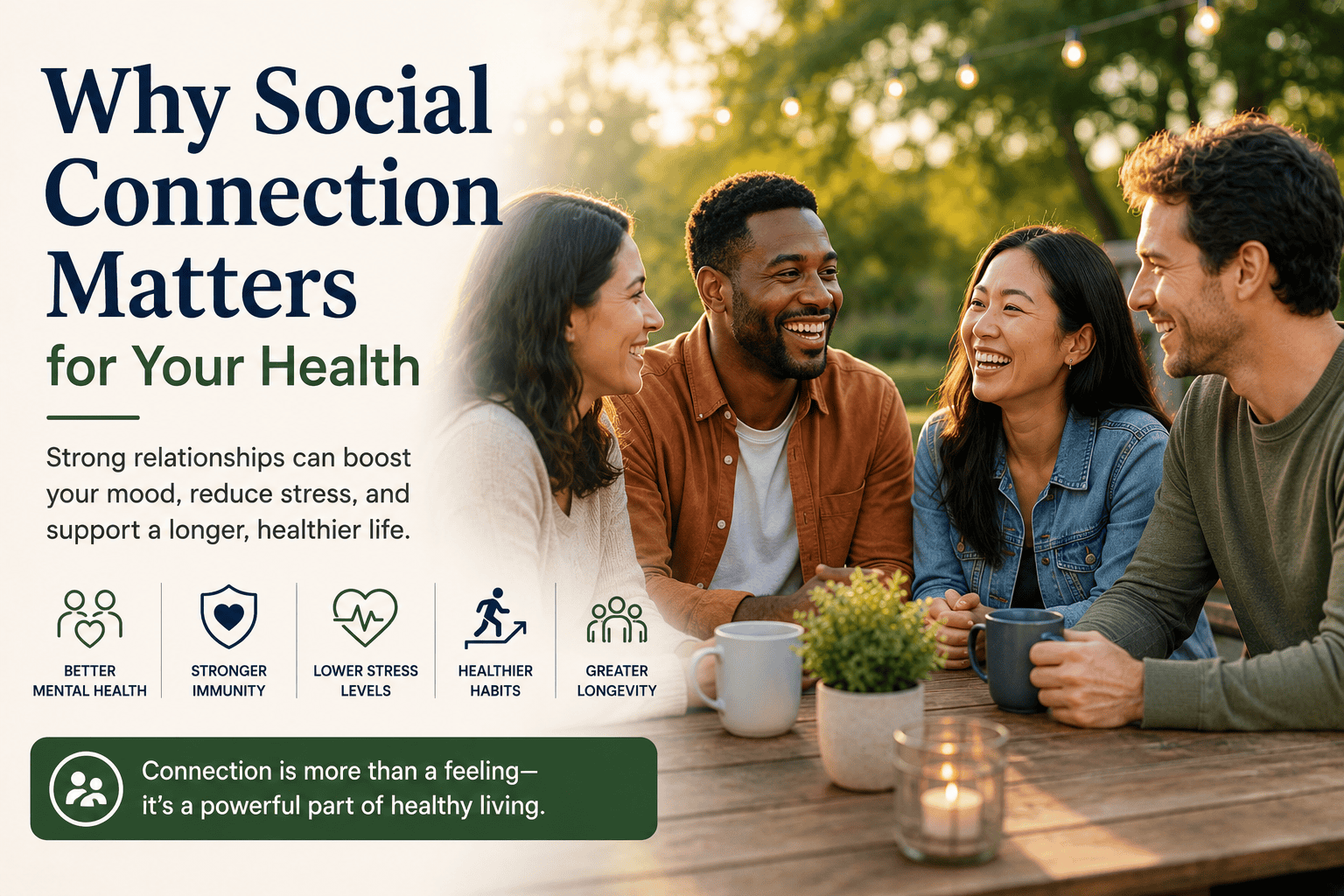
Social Connection and Health: Why Social Connection Matters for Your Health
Health is often described in terms of food, exercise, sleep, hydration, and stress management.
Those things matter.
But there is another part of healthy living that can be just as important and is sometimes overlooked: social connection.
Humans are social beings. Our relationships with family, friends, coworkers, neighbors, and communities can influence how we feel, how we handle stress, the habits we maintain, and our overall well-being.
The Centers for Disease Control and Prevention (CDC) describes social connection as the size, quality, and variety of our relationships, along with whether those relationships provide the belonging, support, and care we need.
Research increasingly shows that meaningful social connection is associated with better physical and mental health, while loneliness and social isolation are associated with a range of health risks.
But social connection does not mean you need a huge social circle or a constantly busy calendar.
For many people, a few meaningful relationships can be more valuable than dozens of casual interactions.
This guide explains what social connection means, how it can affect your health, the difference between loneliness and social isolation, and practical ways to build more meaningful connection into everyday life.
What Is Social Connection?
Social connection is more than simply being around other people.
The CDC describes social connection in terms of the number and variety of relationships you have, the roles those relationships play, and the positive or negative qualities of those interactions.
It can include relationships with:
- Family members
- Friends
- Romantic partners
- Coworkers
- Neighbors
- Community members
- Clubs or organizations
- People who share your interests
- Other supportive relationships
Social connection can also happen in relatively small moments.
A conversation with a friend.
A walk with a neighbor.
A meal with family.
A regular exercise class.
Helping someone with a project.
Volunteering.
Even a brief but meaningful interaction can contribute to a sense of belonging.
Source reference: CDC, Social Connection
Why Does Social Connection Matter for Health?
Social relationships can influence health in several different ways.
Supportive relationships can provide emotional support, practical assistance, companionship, encouragement, and a sense of belonging.
The CDC notes that strong social connections are associated with longer, healthier lives and can help with stress, anxiety, depression, physical activity, healthy eating, and sleep.
Source reference: CDC, Social Connection
Social relationships may also influence health indirectly.
For example, having someone to exercise with can make physical activity easier to maintain.
A friend might encourage you to attend a medical appointment.
Family members may help during a difficult period.
A community can provide a sense of purpose and belonging.
These everyday forms of support can become part of a broader healthy lifestyle.
Social Connection Is Not Just About Having More People Around
It is possible to be surrounded by people and still feel lonely.
You can have hundreds of social media connections and still feel disconnected.
You can live with other people and still feel isolated.
This is why the quality and meaning of relationships matter.
The National Institute on Aging (NIA) distinguishes between social isolation and loneliness. Social isolation generally refers to having relatively few social contacts or relationships, while loneliness is the subjective feeling that your social relationships do not meet your needs.
In other words:
Social isolation is about your social circumstances.
Loneliness is about how connected you feel.
They can occur together, but they are not the same thing.
Source reference: NIA, Loneliness and Social Isolation
What Is Loneliness?
Loneliness is the feeling of being disconnected from the relationships or companionship you want.
It does not necessarily mean that you are physically alone.
Someone may spend a lot of time alone and feel perfectly content.
Someone else may spend every day around coworkers, family members, or other people and still feel deeply lonely.
The important factor is how your social experience compares with what you need or want.
Occasional loneliness is a normal human experience.
It can happen after moving to a new place, changing jobs, ending a relationship, losing someone you care about, becoming a parent, retiring, or going through another major life transition.
The problem is not experiencing loneliness occasionally.
The concern is when loneliness becomes persistent and begins affecting your well-being.
What Is Social Isolation?
Social isolation generally describes having limited contact or interaction with other people.
Someone may become socially isolated because of:
- Living alone
- Moving away from family or friends
- Retirement
- Changes in mobility
- Chronic illness or disability
- Caregiving responsibilities
- Loss of a partner or close friend
- Transportation difficulties
- Financial challenges
- Working or living in an environment with few opportunities for interaction
The NIA notes that older adults can be particularly vulnerable to social isolation and loneliness, although these experiences can affect people at any age.
Source reference: NIA, Loneliness and Social Isolation
Social isolation can also develop gradually.
You may stop attending activities.
You may become less likely to answer messages.
You may spend more time at home.
Eventually, the reduced interaction itself can make reconnecting feel more difficult.
How Can Social Connection Affect Physical Health?
The relationship between social connection and physical health is an active area of research.
Large bodies of evidence have found associations between stronger social relationships and better health outcomes.
For example, a major meta-analysis published in PLoS Medicine examined 148 studies involving more than 300,000 participants and found that stronger social relationships were associated with greater likelihood of survival.
This type of research shows an association rather than proving that social connection alone directly causes longer life.
Source reference: Holt-Lunstad, Smith, and Layton, Social Relationships and Mortality Risk
The CDC similarly notes that strong social bonds are associated with longer and healthier lives and that social connection is associated with lower risk of several serious health problems.
Source reference: CDC, Social Connection
The important takeaway is not that friendship replaces medical care, exercise, or nutrition.
It is that relationships appear to be one part of the broader picture of health.
Social Connection and Stress
Supportive relationships can also influence how we deal with stressful experiences.
When something difficult happens, having someone you trust to talk with can change the experience.
A supportive person may:
- Listen without judgment
- Help you think through a problem
- Provide practical assistance
- Offer encouragement
- Help you feel less alone
- Give you a reason to step away from the problem for a while
The CDC notes that stable and supportive relationships can help people cope with stressful life challenges.
Source reference: CDC, Social Connection
This does not mean that talking to someone will make a stressful situation disappear.
It means you do not necessarily have to handle every difficult experience by yourself.
That distinction matters.
Social Connection and Mental Well-Being
Relationships can play an important role in emotional well-being.
The CDC identifies social connection as relevant to stress, anxiety, depression, and overall well-being.
The NIH likewise reports that loneliness and social isolation are associated with poorer health and mental health outcomes.
Source reference: NIH, Build Social Bonds to Protect Health
Connection can provide something that is difficult to create alone: a sense that other people know you, care about you, and are available when you need support.
That might come from a close friend.
It might come from family.
It might come from a community group.
It might even come from a regular relationship with someone you see in your everyday life.
The form can vary considerably.
Social Connection Can Support Healthy Habits
Your relationships can also influence your everyday behavior.
The NIH’s Social Wellness Toolkit points out that social support can help people become more physically active and make other health-related changes.
For example, you might be more likely to go for a walk if someone is expecting you.
You may cook more often when meals are shared.
You may be more likely to attend a class if a friend goes with you.
You may find it easier to maintain a healthy routine when someone else is working toward a similar goal.
Source reference: NIH, Social Wellness Toolkit
This is one reason social connection fits naturally alongside the other topics in our Healthy Living section.
Healthy habits are often easier to maintain when your environment and relationships support them.
Does Social Media Count as Social Connection?
It can—but not all digital interaction provides the same experience.
Technology can make it easier to maintain relationships across distance.
A video call with family.
A meaningful conversation by text.
A supportive online community.
A group organized around a shared interest.
These can all provide forms of connection.
At the same time, spending time online does not automatically eliminate loneliness.
The quality of the interaction matters.
The U.S. Surgeon General’s advisory on social connection recognizes that digital environments can be part of modern social life while also noting that technology can have both positive and negative effects on connection.
Source reference: U.S. Surgeon General, Our Epidemic of Loneliness and Isolation
A useful question is not simply:
“How much time am I spending online?”
Instead ask:
“Do the ways I connect online leave me feeling supported and connected, or more isolated?”
How Much Social Interaction Do You Need?
There is no universal daily or weekly number.
Unlike physical activity, there is no simple recommendation saying that every adult needs a specific number of hours of social interaction.
People have different personalities, schedules, relationships, responsibilities, and preferences.
Some people enjoy frequent social activity.
Others need more solitude.
Being introverted does not mean you are unhealthy, and enjoying time alone is not the same as being lonely.
The goal is not maximum social activity.
The goal is enough meaningful connection to meet your own social and emotional needs.
Simple Ways to Build More Social Connection
You do not need to completely change your social life.
Small actions can create more opportunities for connection.
1. Reach Out First
Send a message to someone you have been thinking about.
It does not need to be complicated.
Try:
“Hey, I was thinking about you. How have you been?”
A simple check-in can reopen a relationship that has become less active.
The CDC specifically recommends small acts of connection, such as checking in with someone, as a way to build meaningful relationships.
Source reference: CDC, Improving Social Connectedness
2. Make Plans Instead of Saying “We Should Get Together”
“We should get together sometime” sounds good but often never happens.
Instead, make the invitation specific.
Try:
“Would you like to take a walk Saturday morning?”
Or:
“Want to grab coffee next week?”
A specific invitation makes it easier for both people to say yes.
3. Turn Connection Into a Routine
Regular contact is often easier to maintain than occasional attempts to reconnect.
You could:
- Call a family member every Sunday
- Have coffee with a friend once a month
- Walk with a neighbor twice a week
- Schedule a regular game night
- Join a recurring class
- Have dinner with family on a particular evening
The goal is to create predictable opportunities for connection.
4. Combine Social Connection With Healthy Habits
You can accomplish more than one healthy behavior at once.
Try:
- Walking with a friend
- Cooking dinner together
- Taking a fitness class
- Gardening with someone
- Hiking with family
- Joining a recreational sports group
- Meeting someone for coffee after a walk
The NIH recommends shared activities and group-based activities as practical ways to strengthen social connection while supporting healthy behaviors.
Source reference: NIH, Social Wellness Toolkit
5. Join Something You Actually Enjoy
You don’t have to join a generic social group.
Think about activities you already like.
Examples include:
- Book clubs
- Gardening groups
- Walking groups
- Art classes
- Volunteer organizations
- Community classes
- Recreational sports
- Music groups
- Hobby clubs
- Local educational programs
Shared interests give people something to talk about and create a natural reason to interact.
6. Volunteer
Helping others can provide both social interaction and a sense of purpose.
Volunteering can be particularly useful when you are looking for connection but do not necessarily want a traditional social gathering.
The NIA lists volunteering and participating in community activities among ways people can strengthen social connection.
Source reference: NIA, Tips for Staying Connected
7. Reconnect With Someone From Your Past
Not every relationship needs to be rebuilt from scratch.
Think about someone you used to enjoy spending time with.
A former coworker.
An old friend.
A family member you have lost touch with.
A former classmate.
You may be surprised how easy it is to restart a conversation.
8. Spend More Time in Shared Spaces
Connection sometimes begins simply by being around other people.
A library.
A community center.
A coffee shop.
A park.
A local class.
A neighborhood event.
You don’t have to turn every outing into a conversation.
Simply creating more opportunities for interaction can make social connection easier.
What If You Feel Awkward Reaching Out?
That is normal.
If you have been socially withdrawn for a while, reaching out can feel uncomfortable.
You may worry that someone will say no.
You may feel like you have nothing interesting to talk about.
You may wonder whether the other person even wants to hear from you.
Try not to make the first interaction carry too much weight.
You are not trying to immediately rebuild a lifelong friendship.
You are simply opening a door.
A short message can be enough.
If someone does not respond, that does not necessarily mean they do not care about you. People have busy lives, changing priorities, and their own challenges.
Try another person.
What If You’re Surrounded by People but Still Feel Lonely?
This can be particularly difficult.
If you regularly interact with people but still feel disconnected, increasing the number of interactions may not solve the problem.
Instead, consider the quality of your relationships.
Ask yourself:
- Do I have someone I can talk to honestly?
- Do I feel understood by the people around me?
- Do I have relationships where I can be myself?
- Do I spend enough time with people I genuinely enjoy?
- Am I avoiding deeper conversations?
- Are most of my interactions focused on work or responsibilities?
- Is there someone I would like to become closer to?
Sometimes the answer is not “meet more people.”
It may be “invest more deeply in the relationships I already have.”
What If You Prefer Being Alone?
There is nothing inherently unhealthy about enjoying solitude.
Time alone can provide rest, reflection, creativity, and independence.
The important distinction is between chosen solitude and unwanted isolation.
If you enjoy spending a quiet evening by yourself and feel satisfied afterward, that is very different from wanting connection but feeling unable to find it.
Healthy living does not require becoming highly social.
It requires paying attention to whether your social and emotional needs are being met.
When Should Loneliness Be Taken Seriously?
Occasional loneliness is part of being human.
But persistent loneliness or social isolation deserves attention, particularly if it begins affecting your daily life or overall well-being.
The NIA notes that loneliness and social isolation are associated with increased risks of several physical and mental health problems.
Source reference: NIA, Loneliness and Social Isolation
Consider talking with a healthcare professional or mental health professional if you are experiencing persistent loneliness along with:
- Depression
- Significant anxiety
- Loss of interest in activities
- Major changes in sleep
- Major changes in appetite
- Difficulty functioning day to day
- Feelings of hopelessness
- Persistent distress
You do not need to wait until the problem becomes severe before asking for support.
Social Connection During Major Life Changes
Some periods of life naturally make connection more difficult.
Moving.
Starting a new job.
Retirement.
Becoming a parent.
Ending a relationship.
Losing someone close to you.
Recovering from illness.
Changes in mobility.
These transitions can disrupt established routines and relationships.
If your social world changes, give yourself permission to rebuild gradually.
You do not have to recreate your previous social life exactly.
A new routine may look different.
One new friend.
One weekly activity.
One regular phone call.
One community connection.
Those can be meaningful beginnings.
A Simple Weekly Social-Connection Routine
Social connection does not need to become another item on a giant wellness checklist.
A simple weekly approach might look like this:
Once a week: Reach out to someone you care about.
Once a week: Spend time with another person in person if possible.
Once a week: Participate in a shared activity.
During the week: Respond to messages instead of repeatedly putting them off.
When someone needs help: Offer what you realistically can.
When you need support: Ask for it.
And remember that these are examples, not requirements.
Your ideal level of social activity may look completely different.
Common Questions About Social Connection and Health:
Does having lots of friends make you healthier?
Not necessarily. The quality, supportiveness, and meaningfulness of relationships appear to matter more than simply having a large number of social contacts.
Can you be lonely even if you have a family?
Yes. Loneliness is about how connected you feel, not simply whether other people are physically present.
Is social isolation the same as loneliness?
No. Social isolation generally refers to limited social contact or relationships, while loneliness refers to the subjective feeling of lacking the connection you want.
Can online friendships be meaningful?
Yes. Digital communication can help people maintain relationships and build communities, especially across distance. The quality of the interaction matters more than whether it happens online or in person.
What if I don’t have many people in my life?
Start small. Reach out to one person, join an activity you genuinely enjoy, volunteer, or look for a community organized around an existing interest.
Is spending time alone unhealthy?
No. Solitude can be healthy and enjoyable. The concern is unwanted isolation or persistent loneliness that negatively affects your well-being.
The Bigger Picture
Healthy living is more than what you eat or how often you exercise.
It is also about how you live your everyday life.
The relationships around you can influence your stress, habits, sense of belonging, emotional well-being, and ability to navigate difficult periods.
That does not mean you need a huge social circle.
It does not mean you need to attend events every night.
And it certainly does not mean you need to become someone you are not.
Instead, think about the relationships that make you feel supported, valued, understood, and connected.
Then look for small ways to invest in them.
A phone call.
A shared meal.
A walk.
A conversation.
A helping hand.
A standing weekly plan.
These ordinary moments can become meaningful parts of a healthy life.
The Bottom Line
Social connection is an important part of overall well-being.
Research has found consistent associations between stronger social relationships and better health, while loneliness and social isolation are associated with poorer physical and mental health.
But connection is not about having the biggest social network.
It is about having relationships that provide meaningful interaction, support, belonging, and companionship.
If your social life feels healthy and satisfying, continue nurturing it.
If you have been feeling disconnected, start small.
Reach out to someone.
Make a specific plan.
Join something you enjoy.
Combine social time with activities that already support your health.
And if loneliness has become persistent or is affecting your mental health or ability to function, consider talking with a healthcare or mental health professional.
Healthy living isn’t about doing everything perfectly.
Sometimes, it simply means remembering that we don’t have to do everything alone.
Sources
- Centers for Disease Control and Prevention (CDC). Social Connection.
- Centers for Disease Control and Prevention (CDC). Improving Social Connectedness.
- National Institute on Aging (NIA). Loneliness and Social Isolation.
- National Institute on Aging (NIA). Loneliness and Social Isolation — Tips for Staying Connected.
- National Institutes of Health (NIH). Build Social Bonds to Protect Health.
- National Institutes of Health (NIH). Social Wellness Toolkit.
- Office of the U.S. Surgeon General. Our Epidemic of Loneliness and Isolation: The U.S. Surgeon General’s Advisory on the Healing Effects of Social Connection and Community.
- Holt-Lunstad J, Smith TB, Layton JB. Social Relationships and Mortality Risk: A Meta-analytic Review. PLoS Medicine.