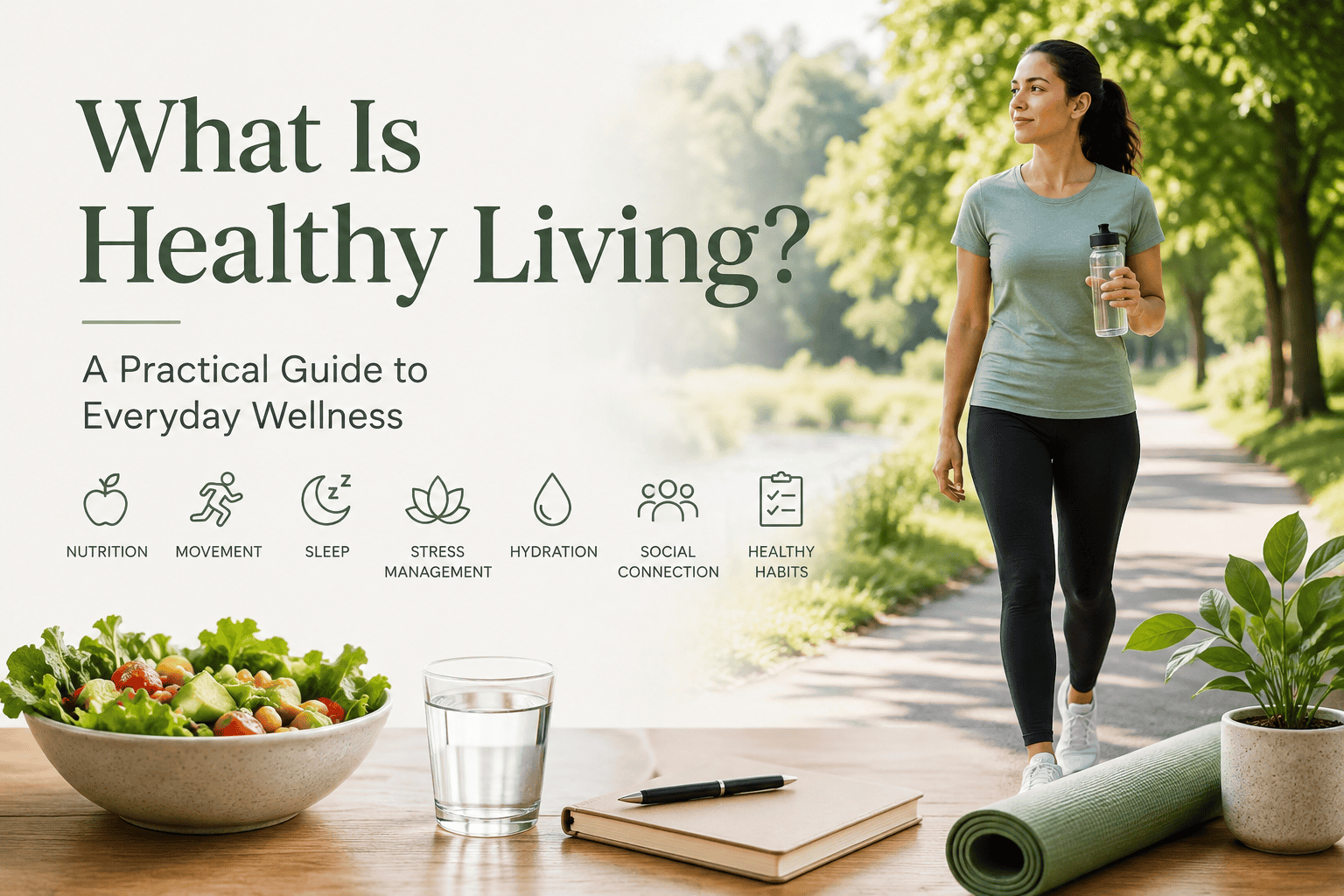
What Is Healthy Living? A Practical Guide to Everyday Wellness
Healthy living can sometimes sound like a complicated checklist.
Eat perfectly. Exercise every day. Sleep eight hours. Drink enough water. Manage stress. Take the right supplements. Avoid everything that’s “bad.”
Real life doesn’t work that way.
Healthy living is better understood as the collection of everyday habits and choices that support your physical health, mental well-being, and quality of life over time. It isn’t about being perfect or following a rigid routine. It’s about building a lifestyle that gives your body and mind the support they need while still being realistic enough to maintain.
That can include eating a balanced diet, staying physically active, getting enough sleep, managing everyday stress, staying hydrated, maintaining meaningful relationships, and developing routines that support your health.
This guide explains the basics of healthy living and how these different pieces fit together.
What Does Healthy Living Actually Mean?
There isn’t one perfect definition of healthy living that applies to everyone.
A healthy lifestyle generally involves behaviors that support health and well-being while reducing avoidable risks. But the details can look different depending on a person’s age, activity level, responsibilities, preferences, environment, and individual needs.
Healthy living is also about more than avoiding disease.
Health includes your ability to move through daily life, sleep well, manage ordinary challenges, maintain relationships, enjoy activities that matter to you, and have enough energy to participate in your life.
That is why a healthy lifestyle shouldn’t be reduced to a number on a scale or a single health metric.
Instead, think of healthy living as a collection of habits that work together.
The Main Pieces of a Healthy Lifestyle
Healthy living has several interconnected parts.
The major areas we’ll explore in this section include:
- Nutrition
- Physical activity
- Sleep
- Stress management
- Hydration
- Healthy habits and routines
- Social connection
These areas overlap more than you might expect.
For example, regular physical activity can support better sleep. Getting enough sleep can make it easier to maintain healthy eating and activity habits. Social connection can provide support during stressful periods. And a nutritious diet can provide the energy and nutrients needed to stay active.
You don’t have to optimize every area at once.
The goal is to build a foundation that works together.
Nutrition Is One Part of Healthy Living
Food provides the energy and nutrients your body needs to function.
A healthy dietary pattern doesn’t require eating perfectly or eliminating entire categories of food. Instead, it emphasizes variety and nutrient-dense choices while allowing room for individual preferences.
Our [Nutrition section] provides a deeper look at balanced eating, protein, dietary fiber, carbohydrates, dietary fats, vitamins, and minerals.
A useful starting point is our guide to [What Is Good Nutrition?], which explains the fundamentals of building a balanced diet.
The important thing is to think about your overall eating pattern rather than judging your health based on one meal or one food.
A nutritious breakfast doesn’t cancel out an otherwise inconsistent diet, just as one indulgent meal doesn’t ruin a healthy eating pattern.
Consistency over time matters much more than perfection.
Physical Activity Matters
Movement is another major part of healthy living.
Physical activity supports cardiovascular health, muscle and bone health, physical function, sleep, and mental well-being. The CDC notes that regular physical activity provides both immediate and long-term health benefits and can reduce the risk of several chronic diseases.
Federal guidelines for adults recommend at least 150 minutes of moderate-intensity aerobic activity each week, along with muscle-strengthening activities on at least two days per week. Importantly, that activity can be spread throughout the week, and some activity is better than none.
You don’t necessarily need a gym membership or an elaborate workout plan.
Walking, cycling, swimming, dancing, gardening, recreational sports, and other activities can all contribute to a more active lifestyle.
Our upcoming guide to [how much exercise you really need] will take a closer look at physical activity recommendations and practical ways to get started.
Sleep Is Part of Your Health, Too
Sleep isn’t simply time when your body stops doing things.
It is an important biological process that supports physical health, mental function, mood, and daily performance.
For adults, the CDC recommends at least seven hours of sleep per night. Yet many adults regularly get less than that.
Sleep health involves more than the number of hours you spend in bed. Regularity, sleep quality, the sleep environment, and possible sleep disorders can all matter.
Simple habits can sometimes make a difference, such as maintaining a consistent sleep schedule, creating a comfortable sleep environment, and giving yourself enough time to sleep.
We’ll explore this topic in greater depth in our upcoming article on [sleep and your health].
If you regularly have difficulty falling asleep, staying asleep, or feel excessively tired despite getting enough opportunity to sleep, it’s worth discussing the issue with a healthcare professional.
Managing Everyday Stress
Stress is a normal part of life.
Work deadlines, family responsibilities, financial concerns, unexpected problems, and major life changes can all create stress. The goal isn’t necessarily to eliminate every stressful experience.
Instead, healthy living includes developing ways to respond to everyday stress and recover from it.
Physical activity, adequate sleep, time outdoors, relaxation techniques, enjoyable activities, and supportive relationships can all be part of a healthy approach to managing stress.
It can also help to recognize that stress management isn’t about finding one perfect technique.
What works for one person may not work for another.
Our upcoming guide to [managing everyday stress] will explore practical strategies in more detail.
Hydration and Healthy Living
Water is essential for normal body function.
Your body uses water to regulate temperature, support circulation, transport nutrients, remove waste, and maintain other important processes.
How much fluid you need can vary depending on factors such as activity, weather, diet, body size, and other individual circumstances.
That means there isn’t necessarily one exact amount that every person needs to drink every day.
For many people, drinking water regularly and paying attention to thirst is a practical starting point. During exercise, hot weather, or other situations involving increased fluid losses, your needs may be higher.
Our upcoming guide to [hydration and how much water you really need] will take a closer look at fluid needs and common hydration questions.
Healthy Habits Are More Important Than Perfect Days
One of the biggest misconceptions about healthy living is that you need to completely change your lifestyle overnight.
Usually, that isn’t necessary.
Small behaviors repeated consistently can become meaningful parts of a healthy routine.
For example:
- Taking a short walk after dinner
- Going to bed at a more consistent time
- Adding a serving of vegetables to lunch
- Keeping a water bottle nearby
- Taking regular breaks from prolonged sitting
- Preparing a few nutritious meals at home each week
- Making time for friends or family
- Spending a few minutes outside each day
None of these habits is revolutionary.
That’s part of the point.
A healthy lifestyle is much easier to maintain when healthy choices fit naturally into your existing routine.
Our upcoming article on [building healthy habits that last] will explore how to make these behaviors easier to maintain over time.
Social Connection Is Part of Wellness
Healthy living isn’t only about what you do by yourself.
Relationships and social connection are important parts of overall health and well-being. The CDC notes that supportive social connections are associated with better health and can help people cope with stress and maintain healthier behaviors.
Connection can come from many places:
- Family
- Friends
- Coworkers
- Neighbors
- Community groups
- Clubs and recreational activities
- Volunteer organizations
You don’t need a huge social network.
A few supportive relationships can be meaningful.
Making time to talk with someone, share a meal, participate in a group activity, or simply spend time with people you enjoy can be part of a healthy lifestyle.
We’ll explore this topic more in our upcoming guide to [why social connection matters for your health].
You Don’t Have to Change Everything at Once
If you’re trying to improve your health, it can be tempting to create a long list of goals.
Exercise every day.
Completely change your diet.
Drink more water.
Sleep eight hours.
Meditate.
Take supplements.
Lose weight.
Reduce stress.
The problem is that trying to change everything at once can make healthy living feel like another full-time job.
A more practical approach is to choose one or two areas that would make the biggest difference in your everyday life.
Maybe you’re not getting enough sleep.
Maybe you’re sitting for most of the day.
Maybe your meals are inconsistent.
Maybe you rarely make time for friends.
Start there.
Once a habit becomes easier and more automatic, you can build on it.
What About Weight?
Body weight can be an important health consideration, but healthy living shouldn’t be reduced to weight alone.
People can have very different body sizes, fitness levels, eating patterns, and health circumstances.
A healthy lifestyle focuses on behaviors that support health rather than assuming that one particular appearance represents health.
Eating nutritious foods, moving regularly, sleeping adequately, managing stress, and maintaining supportive relationships can all contribute to health regardless of whether the scale changes.
If weight management is one of your goals, it can be useful to approach it as one part of a broader healthy lifestyle rather than the sole measure of success.
Do Supplements Have a Role in Healthy Living?
Sometimes.
Supplements can be useful when someone has a nutrient deficiency, has increased nutritional needs, follows a diet that makes certain nutrients difficult to obtain, or has another reason to supplement.
But supplements aren’t a replacement for healthy habits.
A multivitamin, for example, doesn’t replace a varied diet. A supplement can’t substitute for regular physical activity, adequate sleep, or meaningful social connection.
If you’re considering high-dose supplements or taking multiple products, it’s worth discussing them with a healthcare professional, especially because some nutrients can be harmful in excessive amounts or interact with medications.
Our [Nutrition section] explores vitamins, minerals, and other nutrition topics in more detail.
Healthy Living Looks Different for Everyone
There is no single lifestyle that everyone needs to follow.
Someone who works at a desk may need to prioritize movement throughout the day. Someone who works a physically demanding job may have different activity and recovery needs.
A parent with young children may have very different sleep opportunities than a retiree.
Someone following a vegetarian diet may approach nutrition differently from someone who eats animal products.
And people living with health conditions, disabilities, or other circumstances may need individualized guidance.
That’s why healthy living should be flexible.
The goal isn’t to copy someone else’s routine perfectly. It’s to find practical habits that support your own health and fit into your life.
A Simple Starting Point
If you aren’t sure where to begin, keep it simple.
Try focusing on these seven areas:
Eat a varied diet. Build meals around nutritious foods and aim for variety over time.
Move your body regularly. Find activities you enjoy and look for opportunities to move throughout the day.
Protect your sleep. Give yourself enough time to sleep and develop a consistent routine.
Manage stress. Find healthy ways to decompress and recover from everyday challenges.
Stay hydrated. Drink fluids regularly and pay attention to situations when your needs increase.
Build sustainable habits. Start small enough that your changes are realistic to maintain.
Stay connected. Make time for people and communities that provide support and belonging.
You don’t need to master all seven at once.
Choose one place to start.
The Bottom Line
Healthy living isn’t about following a perfect routine.
It’s about building a collection of everyday behaviors that support your physical health, mental well-being, and quality of life.
Nutrition, physical activity, sleep, stress management, hydration, healthy habits, and social connection all contribute to the bigger picture. They also influence one another, which means improving one area can sometimes make another easier.
The most sustainable approach is usually the simplest one: make small, realistic changes, give them time to become habits, and build from there.
There is no finish line where you suddenly become “perfectly healthy.”
Healthy living is something you practice over time.