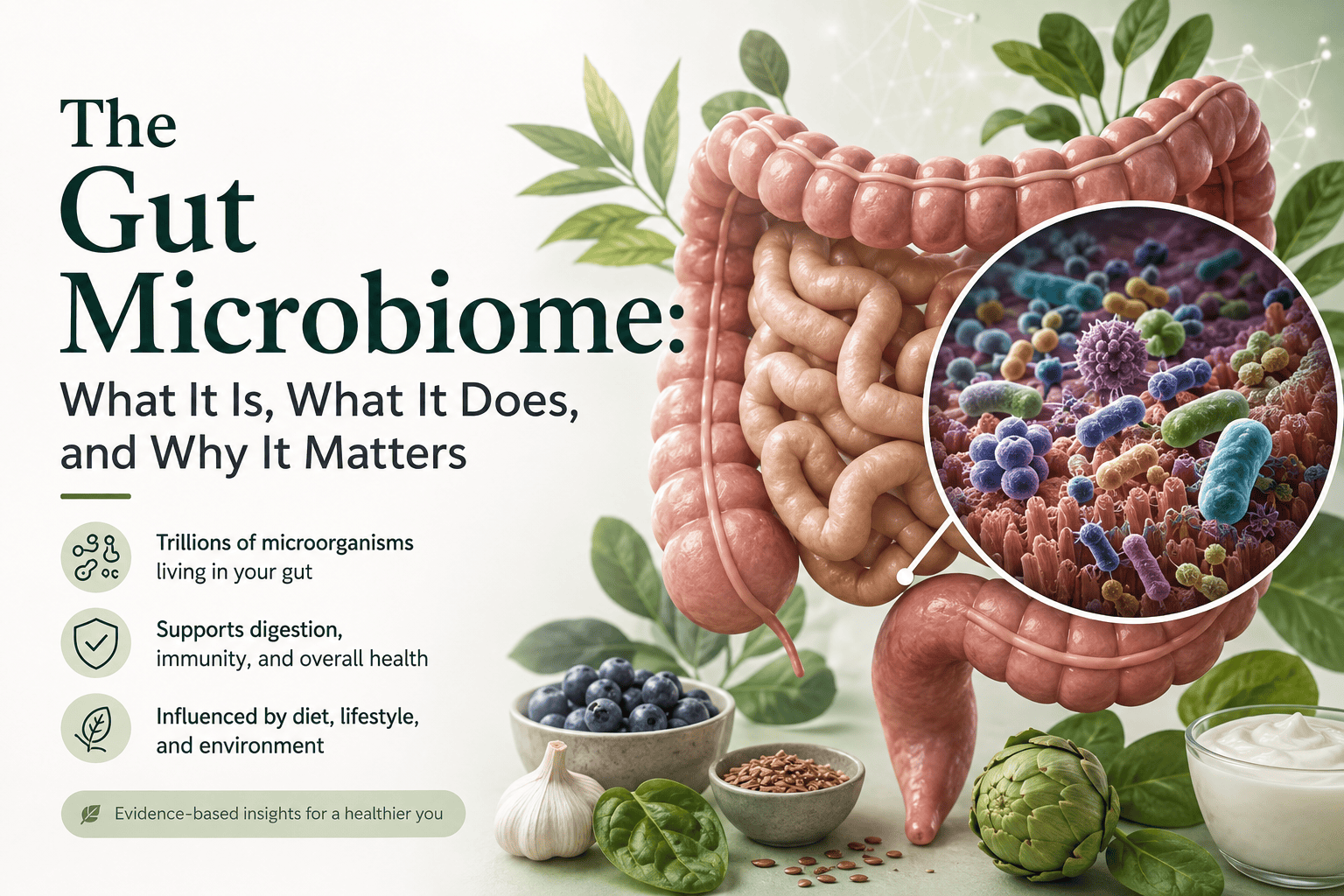
The Gut Microbiome: What It Is, What It Does, and Why It Matters
The gut is home to a remarkable community of microorganisms that quietly interact with the food we eat, our digestive system, and our immune system every day.
You may have heard this community called the gut microbiome, gut microbiota, or simply “gut bacteria.” Although these terms are sometimes used interchangeably, they don’t mean exactly the same thing.
The gut microbiota refers to the microorganisms living in the digestive tract, while the microbiome generally refers to those microorganisms and their genetic material. The community includes bacteria as well as other microorganisms such as fungi and viruses.
So what does this microscopic ecosystem actually do?
Quite a lot—but some of the claims made about the microbiome go far beyond what current research can prove.
This guide looks at what scientists know about the gut microbiome, how it interacts with the body, and what everyday habits can help support a healthy microbial community.
What Is the Gut Microbiome?
The human digestive tract contains a large and diverse community of microorganisms.
These microbes live throughout the gastrointestinal tract, although the colon is particularly rich in microbial life. Different areas of the digestive system provide different environments, meaning the microbial communities aren’t identical from one part of the gut to another.
Your gut microbiome isn’t something you acquire once and then keep unchanged for life.
It is a dynamic ecosystem that can change in response to factors including diet, medications, age, environment, and other aspects of a person’s biology.
That helps explain why researchers increasingly think about the microbiome as an ecosystem rather than simply a collection of individual “good” or “bad” bacteria.
What Does the Gut Microbiome Do?
Researchers are continuing to uncover the many ways gut microorganisms interact with the human body.
Some of the better-established areas include digestion, production of microbial metabolites, protection against certain pathogens, and interactions with the immune system.
1. It Helps Process Certain Foods
Humans cannot completely digest every type of carbohydrate we eat.
Certain dietary fibers and other complex carbohydrates reach the large intestine, where microorganisms can ferment them. This process produces compounds called short-chain fatty acids, including acetate, propionate, and butyrate.
These compounds are an important area of microbiome research because they can interact with cells in the intestine and influence processes involved in metabolism and immune function.
In other words, what you eat doesn’t just provide fuel for your own cells. Some components of food also provide fuel for the microorganisms living in your gut.
2. It Interacts With the Immune System
The digestive tract is an important site of immune activity.
Gut microorganisms interact with the intestinal environment and can influence immune responses. Some microbial products can help regulate immune activity, while the microbiome also contributes to resistance against certain potentially harmful microorganisms.
This doesn’t mean that every change in the microbiome causes an illness—or that changing your microbiome can prevent disease.
The relationship is considerably more complicated.
Researchers are still working to understand which microbial changes are causes of health problems, which are consequences, and which may simply occur alongside them.
3. It Helps Protect Against Some Harmful Microorganisms
The microorganisms that normally live in the gut occupy space and use nutrients that could otherwise be available to invading organisms.
This community can therefore contribute to what’s sometimes called colonization resistance, helping make it more difficult for certain harmful microorganisms to establish themselves.
The gut’s protective environment also involves the intestinal lining, immune system, mucus layer, and many other factors—not the microbiome alone.
What Determines the Composition of Your Gut Microbiome?
There isn’t one standard microbiome that every healthy person should have.
Researchers are increasingly recognizing that healthy microbial communities can differ substantially from one person to another. Diversity is one area of interest, but simply having “more bacteria” or maximizing the number of different species isn’t a complete definition of a healthy microbiome.
Several factors can influence the microorganisms living in your gut.
Diet
Diet is one of the most important factors we can influence.
A diet containing a variety of fiber-rich plant foods provides carbohydrates that many gut microorganisms can use. Fruits, vegetables, beans, whole grains, nuts, and seeds can all contribute different types of dietary fiber.
This is one reason dietary variety matters.
Different plants contain different types of fibers and other compounds, which can support different microbial activities.
Medications
Medications can also affect the gut microbiome.
Antibiotics are a particularly obvious example because they are designed to affect bacteria. Research has also identified medication use more broadly as one of the factors that can shape the microbial community.
That doesn’t mean medications are inherently harmful to the microbiome. Medications can be important and necessary treatments, and decisions about using or stopping medication should always be based on appropriate medical advice.
Age and Environment
The microbiome changes throughout life.
Age, genetics, environment, lifestyle, and other exposures can all influence the microbial community.
This is another reason why there probably isn’t a single “perfect microbiome” that everyone should try to achieve.
What About Probiotics?
Probiotics are living microorganisms that, when consumed in adequate amounts, can provide a health benefit in specific circumstances.
They are available in some fermented foods and in dietary supplements.
But this is an area where marketing can easily get ahead of the science.
Different probiotic strains can have different effects, and evidence for one strain or combination shouldn’t automatically be applied to every probiotic product. Harvard’s Nutrition Source notes that probiotic foods and supplements can vary considerably, while emphasizing the importance of an overall dietary pattern rich in fiber and plant foods.
So “probiotic” doesn’t automatically mean “better gut health.”
The specific microorganism, dose, health condition, and purpose all matter.
We’ll take a much closer look at probiotics in a future article in this Gut Health series.
What About Prebiotics?
Prebiotics are another term you’ll encounter frequently when reading about gut health.
In simple terms, prebiotics are substances that are selectively utilized by microorganisms and provide a health benefit. Many naturally occurring prebiotic substances are found in plant foods.
Fiber is particularly important because many types of dietary fiber reach the colon relatively intact and can be fermented by gut microorganisms.
Foods containing fermentable fibers include many fruits, vegetables, beans, whole grains, and other plant foods.
However, increasing fiber very quickly can cause temporary gas or bloating in some people. Gradually increasing fiber intake and drinking adequate fluids may make the transition easier. People with digestive conditions or significant symptoms may need individualized dietary advice.
How Can You Support Your Gut Microbiome?
You don’t need an elaborate supplement routine to start taking care of your gut.
For most people, the foundation is a varied, nutrient-rich diet.
Focus on variety
Rather than looking for one “superfood” for your microbiome, aim for variety across your overall diet.
Different plant foods provide different types of fiber and other compounds that interact with gut microorganisms.
Eat more fiber-rich foods
Beans, vegetables, fruits, whole grains, nuts, and seeds are useful sources of dietary fiber.
If your current diet is relatively low in fiber, increase your intake gradually rather than making a dramatic overnight change.
Include fermented foods if you enjoy them
Some fermented foods contain live microorganisms. Examples include yogurt with live cultures, kefir, kimchi, sauerkraut, and tempeh.
It’s important to remember that not every fermented food necessarily contains live microorganisms by the time it reaches the grocery store. Processing methods such as heating or pasteurization can affect whether live microbes remain.
Be cautious with microbiome claims
The microbiome is an exciting area of research, but that doesn’t mean every product advertised as “microbiome supporting” has been shown to provide meaningful benefits.
Researchers are still working to determine which microbial characteristics are associated with specific health outcomes and which interventions reliably produce beneficial results.
A healthy gut isn’t something you can measure simply by counting bacteria or taking a particular supplement.
The Bottom Line
The gut microbiome is a complex and constantly changing community of microorganisms that interacts with digestion, the immune system, metabolism, and the intestinal environment.
What we eat is one important factor that shapes this community, which is one reason a varied diet rich in fiber-containing plant foods is a sensible foundation for gut health.
But the science is more complicated than simply labeling bacteria “good” or “bad.”
There is no single microbiome that every person needs to achieve, and more research is needed to understand exactly how specific microorganisms and microbial communities affect individual health.
For now, the most practical approach is to focus on the fundamentals: eat a varied diet, include plenty of fiber-rich foods, make gradual changes when needed, and be skeptical of products that promise to dramatically “reset” or “detox” your microbiome.
As our understanding of the gut microbiome continues to grow, we’ll continue separating established evidence from promising—but still developing—research here at Calm Health Lab.
Sources and Further Reading
- National Institute of General Medical Sciences (NIH) — “What Is the Microbiome?”
- Read the NIGMS articleNational Institute of Environmental Health Sciences (NIH) — “Microbiome”
- Read the NIEHS microbiome pageHarvard T.H. Chan School of Public Health — “The Microbiome”
- Read Harvard’s The MicrobiomeHarvard T.H. Chan School of Public Health — “Probiotics for Gut Health”
- Read Harvard’s Probiotics for Gut HealthRoss, F.C., Patangia, D., Grimaud, G. et al. The interplay between diet and the gut microbiome: implications for health and disease. Nature Reviews Microbiology 22, 671–686 (2024).
- Nature Reviews Microbiology, 2024
- Read the article at Nature
- PubMed:View the PubMed recordMann, E.R., Lam, Y.K. & Uhlig, H.H. Short-chain fatty acids: linking diet, the microbiome and immunity. Nature Reviews Immunology 24, 577–595 (2024).
- Nature Reviews Immunology, 2024
- Read the article at Nature
- PubMed:View the PubMed record