
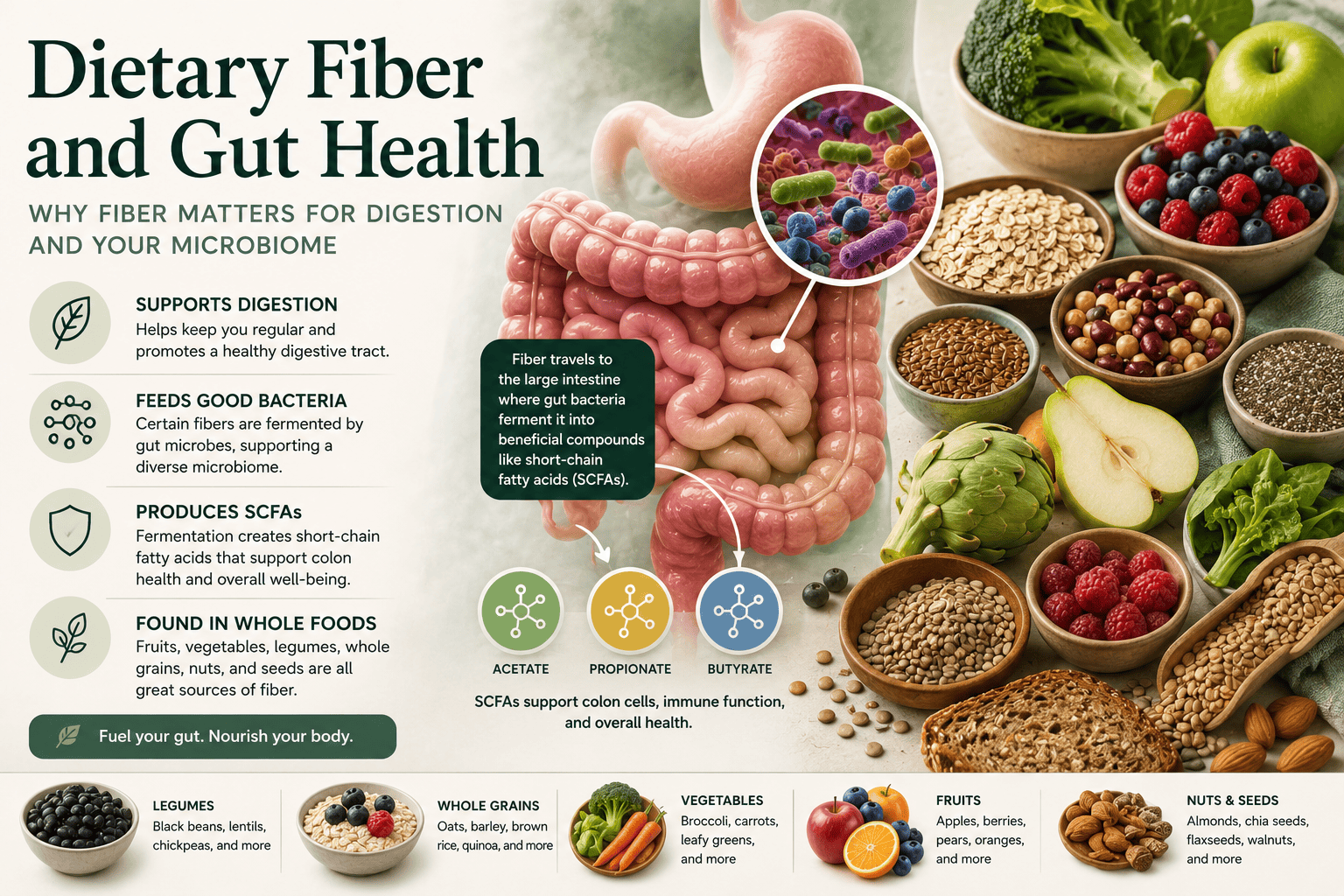
Dietary Fiber and Gut Health: Why Fiber Matters for Digestion and Your Microbiome
If you’re interested in improving your gut health, one of the simplest places to start is with something you’ve probably heard about many times before: dietary fiber.
Fiber is found naturally in foods such as vegetables, fruits, beans, lentils, nuts, seeds, and whole grains. Unlike many other carbohydrates, much of the fiber we eat isn’t broken down and absorbed in the small intestine.
Instead, different types of fiber travel through the digestive system in different ways.
Some help add bulk to stool. Some form gels and slow digestion. Some are fermented by microorganisms in the large intestine. And some do more than one of these things.
That makes fiber much more interesting than simply a nutrient that “keeps you regular.”
Fiber connects food, digestion, the gut microbiome, and overall health.
What Is Dietary Fiber?
Dietary fiber is a type of carbohydrate that the human digestive system cannot completely break down and absorb.
This is an important distinction.
Most digestible carbohydrates are broken down into smaller sugars that can be absorbed in the small intestine. Fiber, however, resists digestion to varying degrees.
Instead, it continues through the digestive tract and can affect the body in several ways depending on its structure and properties.
Harvard’s Nutrition Source explains that fiber includes a wide range of compounds, rather than being a single substance.
This is why it’s more useful to think about types of fiber than simply asking whether a food “has fiber.”
Why Does Fiber Matter for Gut Health?
Fiber can influence digestion in several different ways.
Some types of fiber absorb water and help increase stool bulk. Others form a gel-like substance that can slow the movement of food through the digestive tract.
And certain fibers can be fermented by gut microorganisms.
That last point is especially important when we’re talking about the microbiome.
Some of the carbohydrates that escape digestion in the small intestine reach the large intestine, where gut microorganisms can metabolize them.
The resulting fermentation can produce compounds called short-chain fatty acids (SCFAs).
Research has identified acetate, propionate, and butyrate as major short-chain fatty acids produced by microbial fermentation of dietary carbohydrates and fiber.
A review published in Cell describes these compounds as important bacterial metabolites that can influence several physiological processes. [1]
However, it’s important not to oversimplify this relationship.
Different fibers interact with different microorganisms, and the effects can depend on the type and amount of fiber consumed.
A systematic review of human studies found that fiber interventions did not produce a uniform increase in short-chain fatty acids in healthy adults. The results varied depending on the type, structure, and dose of fiber. [2]
In other words:
More fiber can be beneficial, but fiber isn’t one single thing.
Soluble vs. Insoluble Fiber
You may have heard fiber divided into two categories:
- Soluble fiber
- Insoluble fiber
This distinction can be useful, although modern nutrition science recognizes that fiber has many different properties that don’t always fit neatly into two boxes.
Soluble Fiber
Soluble fiber dissolves in water and can form a gel-like material.
Examples include fiber found in:
- Oats
- Barley
- Beans
- Lentils
- Apples
- Chia seeds
- Some nuts and seeds
Some soluble fibers can slow digestion and influence how quickly carbohydrates are absorbed.
Certain soluble fibers are also readily fermented by gut microorganisms.
Harvard’s overview of dietary fiber explains that properties such as viscosity and fermentability help determine how individual fibers behave in the digestive system.
Insoluble Fiber
Insoluble fiber does not dissolve in water in the same way.
It can add bulk to stool and help move material through the digestive tract.
Foods containing substantial amounts of insoluble fiber include:
- Whole grains
- Wheat bran
- Many vegetables
- Nuts
- Seeds
- Fruits with edible skins
This type of fiber can be particularly helpful for maintaining regular bowel movements.
But again, foods usually contain mixtures of different fiber types, so labeling an entire food as simply “soluble” or “insoluble” doesn’t tell the whole story.
What Is Fermentable Fiber?
Here’s where fiber becomes especially interesting for the gut microbiome.
Some fibers are fermentable, meaning microorganisms in the large intestine can metabolize them.
Humans don’t have the digestive enzymes needed to break down many of these complex carbohydrates completely.
Gut microorganisms can.
During fermentation, bacteria can produce short-chain fatty acids and other metabolites.
Harvard’s research overview of the gut microbiome explains that indigestible fibers can reach the colon, where microbiota ferment them and produce short-chain fatty acids.
This is one of the major ways that what you eat can interact with the microbial ecosystem inside your digestive tract.
Is Fiber a Prebiotic?
Sometimes.
But not all fiber should automatically be called a prebiotic.
A prebiotic is more specific than simply “fiber.”
The International Scientific Association for Probiotics and Prebiotics defines a prebiotic as a substance that is selectively utilized by host microorganisms and provides a health benefit.
Some fibers meet that definition.
Others may affect digestion without functioning as a prebiotic in the strict scientific sense.
This distinction matters because marketing sometimes treats the words “fiber” and “prebiotic” as interchangeable when they aren’t.
What Happens When Gut Bacteria Ferment Fiber?
When certain microorganisms ferment fiber, they can produce short-chain fatty acids.
The three most commonly discussed are:
Acetate
Acetate is generally the most abundant of the major short-chain fatty acids.
It can be used by tissues throughout the body and participates in metabolic signaling.
Propionate
Propionate can be absorbed and transported to the liver, where it participates in metabolic processes.
Butyrate
Butyrate is particularly interesting in gut health research because it can serve as an energy source for cells lining the colon.
Researchers are also studying its effects on intestinal barrier function, immune signaling, and inflammation.
A review of short-chain fatty acids published in Cell describes these microbial metabolites as important links between dietary fiber, the microbiome, and host physiology. [1]
That doesn’t mean eating one particular fiber food will automatically produce a specific health outcome.
The relationship is considerably more complicated.
Does More Fiber Always Mean Better?
Not necessarily.
For many people, increasing fiber intake can be beneficial. But more isn’t always better if the increase is sudden or poorly tolerated.
If someone who normally eats very little fiber suddenly starts consuming large quantities of beans, bran, vegetables, and other high-fiber foods, they may experience:
- Gas
- Bloating
- Abdominal discomfort
- Changes in bowel movements
Harvard’s discussion of the gut microbiome and fiber specifically notes that suddenly increasing certain prebiotic foods can increase gas and bloating.
This doesn’t necessarily mean the foods are “bad for your gut.”
It can simply mean your digestive system needs time to adjust.
How Much Fiber Do You Need?
Fiber needs vary with age, sex, and overall energy intake.
For adults, a commonly used target is roughly 25 to 38 grams per day, depending on the individual.
However, population averages are often considerably lower.
Rather than obsessing over hitting a perfect number every day, a practical approach is to look at your overall eating pattern.
Are you regularly eating:
- Vegetables?
- Fruits?
- Beans or lentils?
- Whole grains?
- Nuts?
- Seeds?
If the answer is “rarely,” there may be an opportunity to increase fiber gradually.
The goal should be a sustainable dietary pattern rather than suddenly adding a large amount of fiber to your diet.
What Are the Best High-Fiber Foods?
One of the easiest ways to increase fiber is to eat a variety of minimally processed plant foods.
Beans and Lentils
Beans, chickpeas, peas, and lentils can provide substantial amounts of fiber along with protein and other nutrients.
Examples include:
- Black beans
- Kidney beans
- Chickpeas
- Lentils
- Split peas
Fruits
Many fruits contain fiber, particularly when eaten whole rather than as juice.
Good examples include:
- Raspberries
- Pears
- Apples
- Oranges
- Berries
- Kiwi
Vegetables
Vegetables provide different types of fiber along with vitamins, minerals, and numerous plant compounds.
Examples include:
- Broccoli
- Brussels sprouts
- Carrots
- Artichokes
- Green peas
- Leafy greens
Whole Grains
Whole grains contain the bran, germ, and endosperm of the grain.
Examples include:
- Oats
- Barley
- Brown rice
- Quinoa
- Whole-grain bread
- Whole-grain pasta
Nuts and Seeds
Nuts and seeds can contribute fiber along with healthy fats and other nutrients.
Examples include:
- Almonds
- Pistachios
- Chia seeds
- Flaxseeds
- Pumpkin seeds
Harvard’s fiber guide provides a useful overview of these food sources and the different properties of their fibers.
How Should You Increase Fiber?
If your current diet is relatively low in fiber, gradual changes are usually more comfortable than making a dramatic increase overnight.
For example, you might:
Start with breakfast.
Add berries, chia seeds, ground flaxseed, or oats.
Improve lunch.
Add vegetables, beans, or a whole-grain option.
Change your snacks.
Try fruit, nuts, or seeds instead of highly refined snack foods.
Build dinner around plants.
Include vegetables, beans, lentils, or whole grains as regular parts of your meals.
And remember to drink adequate fluids.
Fiber and fluid work together in the digestive system, particularly when it comes to stool consistency and regularity.
What About Fiber Supplements?
Fiber supplements can be useful in some situations, but they aren’t automatically better than food.
Whole foods provide fiber alongside vitamins, minerals, and other compounds that supplements don’t necessarily contain.
Different supplemental fibers also have different effects.
Examples include psyllium, methylcellulose, inulin, and partially hydrolyzed guar gum.
Whether a particular supplement is appropriate depends on the individual and the reason for using it.
If you’re considering a fiber supplement to address persistent constipation, diarrhea, abdominal symptoms, or another ongoing digestive problem, it’s worth discussing the situation with a healthcare professional rather than assuming the supplement is the right solution.
Fiber, the Microbiome, and the Big Picture
This brings us back to the gut microbiome.
Our previous article explained that the gut microbiome is a complex community of microorganisms living throughout the gastrointestinal tract.
Now we can add another important piece:
What we eat helps determine what reaches those microorganisms.
Some foods are largely digested and absorbed before reaching the colon.
Other components, including certain fibers and resistant starches, can reach the large intestine and become substrates for microbial metabolism.
The result is a dynamic relationship between:
Food → digestion → fiber → gut microbes → microbial metabolites
This is one reason dietary patterns are often more important than focusing on a single “superfood” or supplement.
A variety of plant foods provides a variety of fibers and other compounds that interact with the digestive system and microbiome in different ways.
The Bottom Line for Dietary Fiber and Gut Health
Dietary fiber is much more than a tool for preventing constipation.
Different types of fiber can influence digestion, stool consistency, nutrient absorption, and the microorganisms living in the large intestine.
Some fibers are fermented by gut bacteria, producing short-chain fatty acids and other metabolites that researchers are actively studying.
But fiber isn’t one single substance, and its effects depend on the type, amount, food source, and individual.
For most people, the most practical approach is simple:
Eat a variety of fiber-rich plant foods and increase your intake gradually if your current diet is low in fiber.
Beans, lentils, fruits, vegetables, whole grains, nuts, and seeds can all contribute.
And as we’ll see in the next article, fiber isn’t the only way to influence the gut microbiome.
We’ll next look at probiotics — what they actually are, where they come from, and what the evidence says about whether probiotic foods and supplements can improve gut health.
Sources & Further Reading
1. Koh A, et al. From Dietary Fiber to Host Physiology: Short-Chain Fatty Acids as Key Bacterial Metabolites. Cell.
https://pubmed.ncbi.nlm.nih.gov/27259147/
2. Vinelli V, et al. Effects of Dietary Fibers on Short-Chain Fatty Acids and Gut Microbiota Composition in Healthy Adults: A Systematic Review. Nutrients. 2022.
https://pubmed.ncbi.nlm.nih.gov/35807739/
3. Harvard T.H. Chan School of Public Health — The Nutrition Source. Fiber.
https://nutritionsource.hsph.harvard.edu/carbohydrates/fiber/
4. Harvard T.H. Chan School of Public Health — The Nutrition Source. The Microbiome.
https://nutritionsource.hsph.harvard.edu/microbiome/
5. Harvard T.H. Chan School of Public Health — The Nutrition Source. Probiotics for Gut Health.
https://nutritionsource.hsph.harvard.edu/probiotics/
6. NCBI Bookshelf. Dietary Fiber and Prebiotics and the Gastrointestinal Microbiota.
https://www.ncbi.nlm.nih.gov/pmc/articles/PMC5390821/