
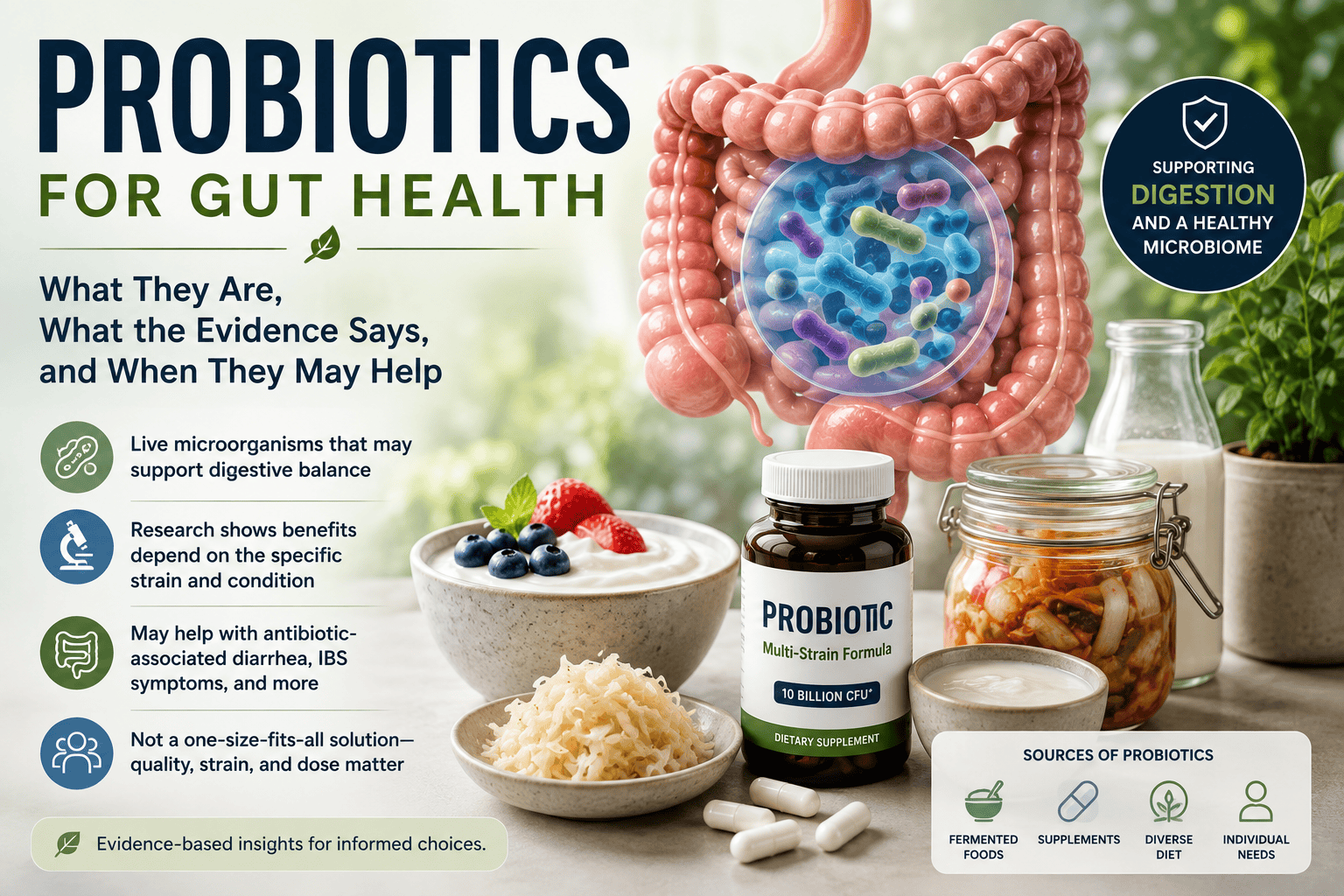
Probiotics for Gut Health: What They Are, What the Evidence Says, and When They May Help
Category: Gut Health
Probiotics are everywhere—from yogurt and fermented foods to capsules, powders, and gummies marketed for digestive health. They are often described as “good bacteria,” and many products promise to support digestion, improve the gut microbiome, or relieve digestive problems.
But the science is more complicated.
Probiotics are not one single type of treatment. Different probiotic products contain different microorganisms, strains, doses, and combinations, and those differences can matter. A probiotic that has been studied for one specific digestive problem cannot automatically be assumed to work for another.
So, do probiotics actually help gut health?
Sometimes—but the answer depends on the specific probiotic, the reason it is being used, and the person taking it.
In this guide, we’ll look at what probiotics are, how they may work, what the research actually shows, and what to consider before choosing a supplement.
What Are Probiotics?
Probiotics are live microorganisms that, when consumed in adequate amounts, are intended to provide a health benefit.
They can include certain species of bacteria as well as some yeasts. Common probiotic organisms include members of the Lactobacillus and Bifidobacterium groups, along with organisms such as Saccharomyces boulardii.
The National Center for Complementary and Integrative Health (NCCIH) explains that probiotics may work in several ways, including interacting with microorganisms already living in the digestive tract, producing substances that influence the surrounding environment, and affecting immune responses.
One important point is easy to overlook:
Not all probiotics are the same.
A probiotic belongs to a particular genus, species, and often a specific strain. Two products may both contain Bifidobacterium, for example, while containing different strains with different research behind them.
That means evidence for one probiotic should not automatically be generalized to every product on the shelf.
Probiotics vs. Prebiotics: What’s the Difference?
The terms probiotics and prebiotics are often used together, but they mean different things.
Probiotics are live microorganisms intended to provide a health benefit.
Prebiotics are substances—often certain types of dietary fiber—that are selectively used by microorganisms in the digestive tract and can influence the composition or activity of the gut microbiota.
In simple terms, probiotics provide microorganisms, while prebiotics provide material that certain microorganisms can use.
There is also a third term you may encounter: synbiotics.
Synbiotics combine probiotics and prebiotics in the same product.
The World Gastroenterology Organisation’s guideline on probiotics and prebiotics provides detailed definitions and emphasizes the importance of evaluating specific microorganisms and products rather than treating all probiotics as interchangeable.
How Might Probiotics Affect the Gut?
Researchers are still working out exactly how individual probiotics affect the human body.
Potential mechanisms include interactions with other microorganisms, changes to the local gut environment, production of biologically active compounds, effects on the intestinal barrier, and interactions with the immune system.
However, it is important not to confuse a plausible mechanism with a proven health outcome.
A probiotic may be able to influence the gut microbiome in a laboratory or clinical study without necessarily producing a meaningful improvement in symptoms for every person who takes it.
This is one reason the evidence surrounding probiotics can appear contradictory.
Different studies may be testing completely different organisms, doses, populations, and health conditions.
What Does the Evidence Actually Show?
The short answer is:
There is evidence that certain probiotics can help in certain situations, but the evidence is not strong enough to say that probiotics generally improve gut health for everyone.
The NCCIH overview of probiotics notes that probiotics have been studied for numerous digestive conditions, but researchers still have important unanswered questions about which probiotics work, how much should be taken, how long they should be used, and who is most likely to benefit.
This distinction is particularly important when evaluating supplement advertising.
A product might contain a probiotic strain that has been studied in humans, but that does not necessarily mean the exact product—or a different strain from the same species—will produce the same result.
Probiotics and Antibiotic-Associated Diarrhea
One of the better-studied uses of probiotics involves diarrhea associated with antibiotic treatment.
Antibiotics can affect the microorganisms living in the digestive tract. In some people, this disruption is followed by diarrhea.
A 2025 Cochrane review of probiotics for preventing Clostridioides difficile-associated diarrhea included 47 studies involving more than 15,000 adults and children receiving antibiotics. The researchers found that probiotics may provide a small benefit in preventing C. difficile-associated diarrhea and may also reduce the risk of antibiotic-associated diarrhea.
However, the researchers also emphasized that the studies used different probiotic products, strains, and doses, making it difficult to determine which probiotic works best.
The American Gastroenterological Association (AGA) similarly recommends specific probiotic formulations in certain antibiotic-related situations rather than recommending probiotics as a general treatment for everyone.
This is a good example of why strain-specific evidence matters.
What About Irritable Bowel Syndrome?
Irritable bowel syndrome (IBS) is another area where probiotics have received substantial attention.
Some studies suggest that certain probiotics may improve individual IBS symptoms. However, the overall evidence remains inconsistent.
The NCCIH’s review of IBS and complementary health approaches notes that some studies have found improvements in certain symptoms, but benefits have not been conclusively demonstrated and different probiotic products can produce different results.
The American College of Gastroenterology’s guidelines have therefore been cautious about recommending probiotics for overall IBS symptoms, partly because studies have tested many different strains and combinations and have produced mixed results.
In other words, saying that “probiotics help IBS” is too broad.
A more accurate statement is that some probiotic preparations have shown potential for certain IBS symptoms, but the evidence is not consistent enough to assume that any probiotic supplement will help.
What About Constipation?
Probiotics have also been investigated for constipation.
Some studies have reported improvements in stool frequency or consistency with particular probiotic strains. However, results vary depending on the organism, dose, population, and study design.
This is another example where the phrase “probiotics for constipation” can oversimplify the evidence.
A better question is:
Which strain, at what dose, for which type of constipation, and in which population?
Those details are what allow researchers to determine whether a particular intervention is actually useful.
What About Inflammatory Bowel Disease?
Probiotics have been studied in inflammatory bowel diseases such as ulcerative colitis and Crohn’s disease.
The evidence is not equally encouraging for both conditions.
The American Gastroenterological Association’s clinical guidance recommends that people with Crohn’s disease or ulcerative colitis use probiotics only in the context of a clinical trial.
That doesn’t mean probiotics have no biological effects in these conditions. Rather, it reflects the uncertainty about whether probiotic treatment provides enough consistent clinical benefit to recommend it as routine therapy.
People with inflammatory bowel disease should not use a probiotic supplement as a replacement for prescribed treatment.
Do Fermented Foods Count as Probiotics?
This is an important distinction.
Foods such as yogurt, kefir, sauerkraut, kimchi, and other fermented foods may contain live microorganisms. But a fermented food is not automatically a probiotic in the scientific sense.
For a microorganism to be considered a probiotic, it needs to be a live microorganism administered in an adequate amount and have demonstrated a health benefit.
The International Scientific Association for Probiotics and Prebiotics and researchers in the field distinguish between fermented foods and probiotic products because the microorganisms and health effects can vary substantially from one food to another.
That doesn’t mean fermented foods are unhelpful.
A 2024 review in Nature Reviews Gastroenterology & Hepatology discussed how fermented foods can provide microorganisms and other compounds that may influence gastrointestinal health, while also emphasizing the need for more rigorous human trials to establish specific health benefits.
For everyday nutrition, fermented foods can be part of a varied diet. But they shouldn’t automatically be treated as interchangeable with a clinically studied probiotic strain.
How Should You Choose a Probiotic?
If you’re considering a probiotic supplement, the biggest mistake is choosing one based only on the number of bacteria listed on the front of the bottle.
Instead, look for information about:
1. The specific strain
A product should ideally identify the microorganism clearly, including the strain when applicable.
Research on one strain does not automatically prove that another strain will have the same effect.
2. The reason you’re taking it
Are you trying to prevent antibiotic-associated diarrhea?
Are you looking for help with a specific digestive symptom?
Or are you simply hoping to improve your overall gut health?
The evidence is different for each situation.
3. The research behind the specific product
Look for human clinical trials involving the same strain or combination of strains.
A long list of scientific-sounding bacterial names isn’t the same thing as strong evidence.
4. The dose and storage instructions
Some probiotic products require refrigeration, while others are designed to remain stable at room temperature.
Follow the manufacturer’s storage instructions, and pay attention to expiration dates.
5. Transparent labeling
A reputable product should clearly identify its microorganisms and provide useful information about the amount supplied.
Be skeptical of products that make sweeping promises such as “detoxes your gut,” “balances all your bacteria,” or “fixes digestive problems.”
The science generally isn’t that simple.
Do You Need a Probiotic If You’re Healthy?
Not necessarily.
There is currently no strong scientific basis for saying that every healthy person needs a probiotic supplement.
The gut microbiome is a complex ecosystem, and supporting it involves much more than adding a capsule containing a handful of microorganisms.
Dietary patterns, fiber intake, physical activity, medications, sleep, age, and many other factors can influence the gut microbiome.
For many people, a sensible starting point is to focus on overall dietary quality rather than assuming a probiotic supplement is required.
That can include eating a variety of plant foods, getting adequate dietary fiber, and including fermented foods if they fit comfortably into your diet.
Are Probiotics Safe?
For generally healthy people, probiotics are usually well tolerated, although they can sometimes cause temporary digestive symptoms such as gas or bloating.
But “natural” does not mean “risk-free.”
The NCCIH notes that the risk of serious complications can be higher in people who are severely ill or have compromised immune systems. Serious infections associated with probiotics have been reported in vulnerable populations.
The U.S. Food and Drug Administration has also warned healthcare providers about the risk of severe, potentially fatal infections in premature infants given probiotics.
If you have a serious medical condition, a weakened immune system, are hospitalized, or are considering probiotics for a child or infant, it is especially important to discuss the decision with a qualified healthcare professional.
The Bottom Line with Probiotics for Gut Health
Probiotics are neither a miracle cure nor a useless supplement.
The evidence suggests that some specific probiotic strains can provide benefits in specific situations, including certain cases involving antibiotic-associated diarrhea. But the evidence does not support treating all probiotics as though they have the same effects.
The most important lesson is this:
When it comes to probiotics, the strain matters.
A product that works in one clinical trial cannot automatically be assumed to work for every digestive problem or every person.
If you’re considering a probiotic, look beyond the marketing claims. Identify the specific strain, understand what it has actually been studied for, and consider whether the evidence matches your particular goal.
And remember that a probiotic supplement is only one small piece of the much larger picture of gut health.
A varied, fiber-rich diet, regular physical activity, adequate sleep, and appropriate medical care all play important roles in supporting overall health.
Sources and Further Reading
- National Center for Complementary and Integrative Health (NCCIH) — Probiotics: Usefulness and Safety
- National Center for Complementary and Integrative Health (NCCIH) — 5 Things To Know About Probiotics
- American Gastroenterological Association — Role of Probiotics in the Management of Gastrointestinal Disorders
- World Gastroenterology Organisation — Probiotics and Prebiotics: Global Guidelines
- Cochrane — Probiotics for the Prevention of Clostridioides difficile-Associated Diarrhea in Adults and Children Receiving Antibiotics
- Mukherjee A, Breselge S, Dimidi E, et al. Fermented foods and gastrointestinal health: underlying mechanisms. Nature Reviews Gastroenterology & Hepatology. 2024;21:248–266. Read the review
Medical Disclaimer
This article is provided for educational and informational purposes only. It is not intended to replace professional medical advice, diagnosis, or treatment. If you have a medical condition, take medications, or are considering a dietary supplement for a specific health concern, consult a qualified healthcare professional.