
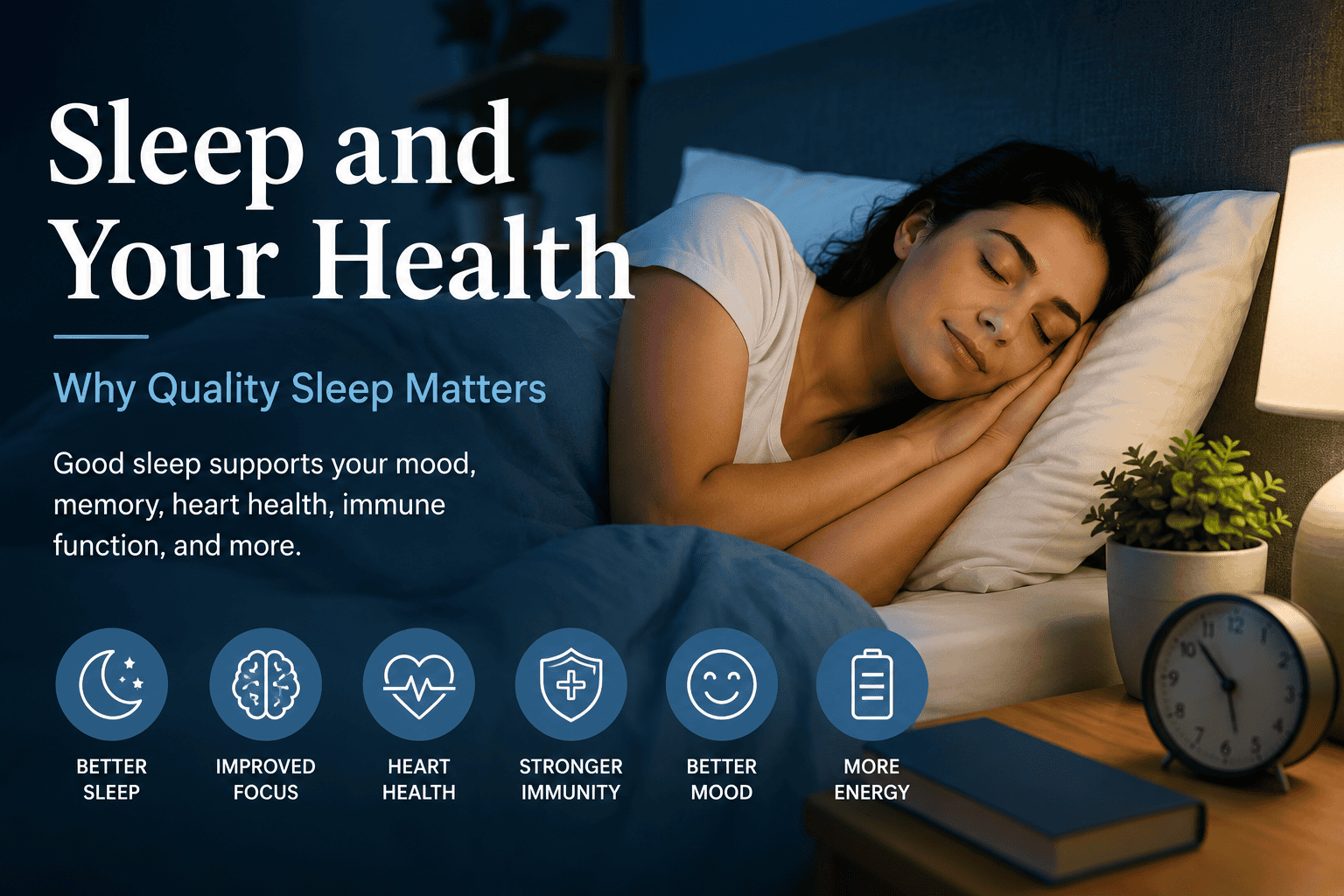
Sleep and Health: Why Quality Sleep Matters
Sleep is easy to overlook.
There are always things competing for your attention—work, family, errands, exercise, screens, entertainment, social connections, and everything else that fills a normal day. When time gets tight, sleep is often the first thing people sacrifice.
But sleep isn’t simply time when your body “shuts down.”
While you’re asleep, your brain and body remain active. Sleep supports memory, learning, emotional regulation, metabolism, immune function, physical recovery, and many other processes that influence how you feel and function during the day.
And getting enough sleep isn’t the whole story.
Sleep quality, regularity, timing, and duration all matter.
This guide explains why sleep is so important, how much adults generally need, what quality sleep actually means, and practical ways to build better sleep habits.
Why Is Sleep Important?
Sleep is a basic biological need.
According to the National Heart, Lung, and Blood Institute (NHLBI), sleep affects many of the body’s systems, including the brain, metabolism, cardiovascular system, and immune system.
During sleep, your brain processes information and supports learning and memory. Your body also carries out processes involved in physical repair and recovery.
That means sleep isn’t simply about avoiding tiredness the next day.
Consistently poor sleep can affect:
- Concentration and attention
- Memory and learning
- Mood and emotional regulation
- Reaction time and decision-making
- Appetite and metabolism
- Immune function
- Cardiovascular health
- Physical recovery
- Daytime energy and performance
The NHLBI explains that sleep deficiency can interfere with learning, focusing, decision-making, problem-solving, emotional regulation, and reaction time.
In other words, sleep is part of the foundation that allows many other healthy habits to work well.
How Much Sleep Do Adults Need?
For most adults, the general recommendation is at least 7 hours of sleep per night on a regular basis.
The CDC currently lists the following recommendations:
- Adults ages 18–60: 7 or more hours
- Adults ages 61–64: 7–9 hours
- Adults 65 and older: 7–8 hours
These are general recommendations rather than a guarantee that every individual will feel best at exactly the same number of hours.
The American Academy of Sleep Medicine and Sleep Research Society also recommend that adults regularly obtain at least 7 hours of sleep to promote optimal health and daytime alertness.
The important word is regularly.
Sleeping five or six hours most nights and occasionally trying to make up for it on the weekend isn’t the same as consistently getting adequate sleep.
Are Seven Hours Really Enough?
Seven hours is generally considered a minimum recommendation for healthy adults, but individual sleep needs vary.
Some people naturally need somewhat more sleep than others.
Your age, health, lifestyle, schedule, and individual biology can all influence how much sleep you need.
Rather than obsessing over one exact number, pay attention to the bigger picture.
Are you consistently waking up refreshed?
Can you stay alert during the day?
Do you regularly feel like you could fall asleep while sitting quietly?
Are you relying heavily on caffeine to get through the day?
If you regularly feel exhausted despite allowing enough time for sleep, the issue may be sleep quality or an underlying sleep problem rather than simply needing to spend more time in bed.
What Happens While You Sleep?
Sleep isn’t one uniform state.
Your brain cycles through different stages of sleep throughout the night.
According to the NHLBI, sleep consists of two major phases:
- Non-REM sleep
- REM sleep
Non-REM sleep includes three stages. The deepest stage, often called slow-wave or deep sleep, tends to occur more heavily earlier in the night.
REM sleep is associated with increased brain activity and plays an important role in learning and memory.
These stages repeat in cycles throughout the night. A typical night’s sleep includes multiple cycles rather than one continuous, identical state.
That’s one reason why simply looking at the number of hours you spend in bed doesn’t tell the entire story.
What Does “Quality Sleep” Mean?
Sleep quality is about more than duration.
You might spend eight hours in bed but still wake up feeling exhausted if your sleep is repeatedly interrupted or otherwise disrupted.
Healthy sleep generally involves:
- Getting enough sleep for your age
- Falling asleep without excessive difficulty
- Staying asleep for most of the night
- Waking up feeling reasonably refreshed
- Maintaining a fairly consistent sleep schedule
- Having sleep that supports normal daytime alertness
The CDC describes healthy sleep as involving both enough sleep and good sleep quality.
This is an important distinction.
If you are consistently giving yourself enough time in bed but still don’t feel rested, it’s worth paying attention to the quality and continuity of your sleep.
Why Sleep Regularity Matters
Your body has an internal timing system known as the circadian rhythm.
The NHLBI explains that circadian clocks generally operate on an approximately 24-hour cycle and help coordinate when you’re awake and when you’re ready to sleep.
Light, darkness, activity, meals, and your regular schedule all provide signals that can influence this system.
This is one reason keeping a relatively consistent bedtime and wake time can help.
You don’t necessarily need to go to bed at exactly the same minute every night.
But a wildly different schedule from one day to the next can make it harder for your body to maintain a predictable sleep-wake rhythm.
A consistent routine gives your body clearer signals about when it’s time to be awake and when it’s time to sleep.
How Does Light Affect Sleep?
Light is one of the strongest environmental signals influencing your circadian rhythm.
Morning light helps signal to your body that the day has begun, while darkness helps prepare the body for nighttime.
The NHLBI notes that artificial light can interfere with the body’s normal sleep-wake signals.
This doesn’t mean you need to live in darkness after sunset.
Instead, it can be useful to gradually reduce bright light and stimulating screen use as bedtime approaches.
During the day, getting outside and exposing yourself to natural light—especially earlier in the day—can also help reinforce a healthy day-night rhythm.
Does Screen Time Affect Sleep?
Screens aren’t automatically harmful to sleep, but using phones, tablets, computers, or televisions immediately before bed can make winding down more difficult for some people.
There are several possible reasons.
Bright light can affect circadian signals, while stimulating content can keep your brain engaged when you’re trying to relax.
If you’re scrolling through stressful news, answering work messages, or watching highly stimulating videos right up until bedtime, the issue may be as much about mental stimulation as the screen itself.
A practical approach is to create a short wind-down period before bed.
You might:
- Dim the lights
- Put your phone away
- Read a physical book
- Take a warm shower
- Listen to calm music
- Do light stretching
- Prepare for the next morning
The goal isn’t perfection.
It’s giving your brain a predictable transition from daytime activity to sleep.
How Does Exercise Affect Sleep and Health?
Regular physical activity is another important part of healthy sleep.
Exercise can support overall health and may make it easier to sleep well, while being active during the day can help reinforce a healthy sleep-wake routine.
That doesn’t mean you need an intense workout every day.
Walking, cycling, recreational activities, strength training, and other forms of movement can all contribute to an active lifestyle.
Our article Physical Activity: How Much Exercise Do You Really Need? covers the current exercise recommendations and practical ways to become more active.
Timing can matter for some people, too.
If exercising very close to bedtime leaves you feeling energized rather than relaxed, try moving your workout earlier in the day.
What You Eat Can Affect Sleep Too
Sleep doesn’t exist separately from the rest of your lifestyle.
Nutrition, physical activity, stress, hydration, and sleep all interact as parts of your overall health.
Large or heavy meals immediately before bed can be uncomfortable for some people, while caffeine consumed later in the day can interfere with sleep.
Alcohol can also affect sleep quality even if it initially makes you feel sleepy.
That doesn’t mean you need a complicated “sleep diet.”
Instead, focus on your overall eating pattern and pay attention to foods, drinks, and meal timing that seem to affect your sleep personally.
Our Nutrition section covers the fundamentals of balanced nutrition and how food fits into a healthy lifestyle.
What About Caffeine?
Caffeine can remain active in the body for several hours.
For some people, an afternoon coffee has little noticeable effect. For others, caffeine later in the day can make falling asleep more difficult or reduce sleep quality.
If you struggle with sleep, consider paying attention to when you consume:
- Coffee
- Energy drinks
- Tea
- Pre-workout products
- Cola and other caffeinated beverages
- Some medications containing caffeine
You don’t necessarily have to eliminate caffeine.
Instead, experiment with moving your last caffeinated drink earlier in the day and see whether your sleep improves.
What About Alcohol Before Bed?
Alcohol can make some people feel sleepy initially, but that doesn’t necessarily mean it produces better sleep.
Alcohol can disrupt normal sleep patterns and contribute to nighttime awakenings.
If you’re using alcohol specifically as a way to fall asleep, it’s worth reconsidering that strategy.
A consistent bedtime routine, a comfortable sleep environment, and addressing the underlying reason you’re having trouble sleeping are generally better long-term approaches.
Creating a Better Sleep Environment
Your bedroom doesn’t need to look like a luxury hotel to support good sleep.
A few basics can make a meaningful difference.
Try to keep your bedroom:
- Cool enough to be comfortable
- Dark
- Quiet
- Comfortable
- Primarily associated with sleep and relaxation
The CDC recommends keeping the bedroom cool, dark, and quiet as part of healthy sleep habits.
If noise is unavoidable, some people find that white noise or another consistent background sound helps.
If outside light is a problem, blackout curtains or a sleep mask may help.
The best environment is the one that allows you to sleep comfortably and consistently.
What Is a Good Bedtime Routine?
A bedtime routine doesn’t need to be complicated.
The goal is to create a predictable sequence that tells your body and brain that the day is winding down.
For example:
9:00 PM: Finish work and reduce stimulating activities.
9:15 PM: Dim the lights and prepare for bed.
9:30 PM: Read, stretch, or listen to relaxing music.
10:00 PM: Get into bed.
Your routine might look completely different.
What matters is consistency.
Over time, repeating the same wind-down pattern can make the transition toward sleep feel more automatic.
What If You Wake Up During the Night?
Brief awakenings can happen normally.
The problem is more concerning when you regularly have difficulty returning to sleep or repeatedly wake up throughout the night and feel exhausted during the day.
If you wake up, try to avoid immediately checking the time and becoming frustrated about how many hours remain.
If you can’t fall back asleep after a while, getting out of bed and doing something quiet in dim light may be more helpful than lying there becoming increasingly frustrated.
If nighttime awakenings happen frequently, however, it’s worth discussing the pattern with a healthcare professional.
What If You Can’t Fall Asleep?
Occasional difficulty falling asleep is common.
Stress, travel, illness, schedule changes, caffeine, and many other factors can temporarily disrupt sleep.
But persistent difficulty falling asleep can be a sign that something needs attention.
If you’re regularly spending a long time awake in bed, consider looking at your:
- Caffeine intake
- Evening screen use
- Stress levels
- Exercise habits
- Sleep schedule
- Bedroom environment
- Alcohol use
- Medication
- Overall sleep routine
Sometimes the problem isn’t simply a lack of discipline.
There may be an underlying sleep disorder or another health issue involved.
When Should You Talk to a Doctor About Sleep?
Talk with a healthcare professional if sleep problems are persistent or significantly affect your daytime functioning.
Some signs that deserve attention include:
- Persistent daytime sleepiness
- Loud or frequent snoring
- Gasping or choking during sleep
- Repeated nighttime awakenings
- Persistent difficulty falling asleep
- Regularly waking much earlier than intended
- Feeling unrefreshed despite getting enough time in bed
- Difficulty staying awake while driving or doing other activities
Sleep apnea, insomnia, restless legs syndrome, circadian rhythm disorders, and other conditions can interfere with healthy sleep.
These problems aren’t simply a matter of needing more willpower.
If you suspect a sleep disorder, professional evaluation can help identify the cause and appropriate treatment.
Sleep and Mental Health
Sleep and mental health are closely connected.
A poor night’s sleep can leave you more irritable, emotionally reactive, or mentally foggy the next day.
At the same time, stress, anxiety, and other mental health challenges can make it harder to sleep.
This can create a cycle:
Poor sleep → greater stress → more difficulty sleeping → poorer sleep.
That doesn’t mean every sleep problem is caused by stress, or that improving sleep will solve every mental health concern.
But sleep is an important part of overall mental and emotional well-being.
Creating a consistent nighttime routine, reducing stimulation before bed, and addressing sources of stress can all be useful pieces of a broader approach to healthy living.
Sleep and Physical Health
Sleep also matters for physical health.
The NHLBI notes that ongoing sleep deficiency can affect cardiovascular health, metabolism, immune function, and other body systems.
Sleep deficiency has been associated with increased risk of several chronic health conditions, including high blood pressure, obesity, diabetes, heart disease, and stroke.
That doesn’t mean that one bad night of sleep causes these conditions.
Health outcomes are influenced by many factors.
The important point is that sleep is one of the lifestyle factors that contributes to the overall picture of health.
Just as nutrition and physical activity matter, adequate and restorative sleep belongs in the same conversation.
Can You Catch Up on Sleep?
If you’ve had a few nights of inadequate sleep, getting additional sleep afterward can help you recover from some of the immediate effects of sleep loss.
But regularly sleeping too little and trying to compensate with occasional long sleep isn’t an ideal long-term strategy.
Your body benefits from adequate sleep on a regular basis.
Think of sleep more like nutrition or physical activity.
You wouldn’t expect one exceptionally healthy meal to compensate for months of poor eating habits.
Likewise, one long weekend of sleep doesn’t completely replace the benefits of consistently adequate sleep.
A Simple Sleep Improvement Plan
If your sleep isn’t where you’d like it to be, don’t try to change everything at once.
Start with a few basics.
1. Set a consistent wake time
Choose a wake time that you can maintain most days.
2. Give yourself enough time for sleep
Work backward from your wake time and allow enough opportunity to get at least seven hours, while recognizing that individual needs vary.
3. Get daylight during the day
Morning or daytime outdoor light can help reinforce your body’s internal clock.
4. Move regularly
Include physical activity during the day. Walking and other moderate activities can be a great starting point.
5. Create a wind-down period
Give yourself 20–60 minutes to transition away from stimulating activities before bed.
6. Watch your caffeine timing
If sleep is difficult, experiment with reducing caffeine later in the day.
7. Make your bedroom comfortable
Keep it dark, quiet, and comfortably cool.
8. Address persistent problems
If you’re consistently struggling with sleep despite making healthy changes, talk with a healthcare professional.
The Bigger Picture
Sleep shouldn’t be viewed as something that competes with healthy living.
Sleep is part of healthy living.
Nutrition gives your body the raw materials it needs. Physical activity challenges and strengthens the body. Sleep provides time for restoration, regulation, learning, and recovery.
Our Healthy Living guide looks at how these habits fit together as part of a sustainable approach to everyday wellness.
You don’t need a perfect sleep schedule.
You don’t need to buy expensive supplements or gadgets.
And you don’t need to become obsessed with tracking every minute of sleep.
Start with the fundamentals:
Give yourself enough time to sleep. Keep your schedule reasonably consistent. Create a comfortable sleep environment. Move during the day. Pay attention to caffeine and other habits that affect your sleep. And take persistent sleep problems seriously.
Good sleep isn’t a luxury.
It’s one of the basic building blocks of a healthy life.
Sources
Centers for Disease Control and Prevention. About Sleep.
Centers for Disease Control and Prevention. About Sleep and Your Heart Health.
Centers for Disease Control and Prevention, National Center for Health Statistics. Short Sleep Duration and Sleep Difficulties Among Adults: United States, 2024.
National Heart, Lung, and Blood Institute (NIH). How Sleep Works.
National Heart, Lung, and Blood Institute (NIH). Sleep Deprivation and Deficiency: How Sleep Affects Your Health.
National Heart, Lung, and Blood Institute (NIH). How Sleep Works: Sleep Phases and Stages.
National Institute of Child Health and Human Development (NIH). About Sleep.
American Academy of Sleep Medicine and Sleep Research Society. Recommended Amount of Sleep for a Healthy Adult: A Joint Consensus Statement.
AASM/Sleep Research Society — Adult Sleep Duration Consensus Statement