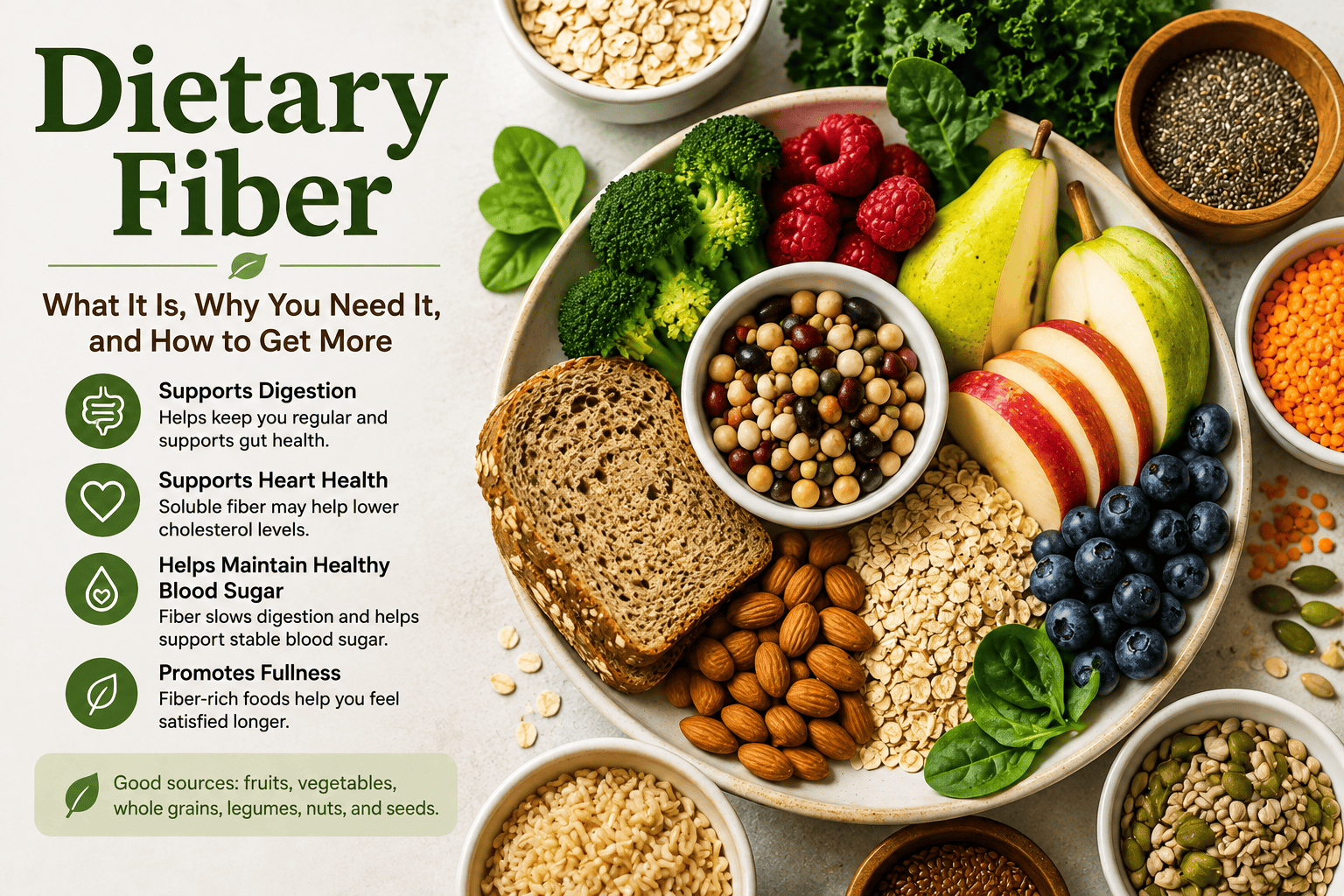
Dietary Fiber: What It Is, Why You Need It, and How to Get More
Dietary fiber is one of those nutrients that gets mentioned constantly when people talk about healthy eating, digestion, and overall wellness. But fiber is more than simply something that “keeps you regular.”
Fiber is a type of carbohydrate that your body does not completely digest. Instead, different types of fiber move through the digestive system and can influence digestion, bowel regularity, the gut microbiome, blood sugar, cholesterol, and how filling a meal feels.
Despite its importance, many people do not get enough fiber from their diets. The good news is that increasing fiber does not require a complicated diet. For most people, the best approach is simply to eat more of the foods that naturally contain it.
What Is Dietary Fiber?
Dietary fiber is found primarily in plant foods. Unlike starches and sugars, which are broken down and absorbed to provide energy, fiber largely resists digestion in the small intestine.
The National Academies describes dietary fiber as carbohydrates and lignin that are intrinsic and intact in plants and are not digested and absorbed in the small intestine. National Academies — Dietary Reference Intakes
There are several different types of fiber, and they do not all behave the same way in the body. That is one reason it is generally more useful to focus on eating a variety of fiber-rich foods rather than trying to maximize one particular type of fiber.
Soluble and Insoluble Fiber
You will often see fiber divided into two broad categories: soluble and insoluble fiber.
Soluble Fiber
Soluble fiber dissolves in water and can form a gel-like material in the digestive tract.
It is found in foods such as:
- Oats
- Barley
- Beans and lentils
- Apples
- Citrus fruits
- Some vegetables
- Nuts and seeds
Some types of soluble fiber can be fermented by bacteria in the colon. This makes fiber particularly interesting when we talk about the gut microbiome.
Insoluble Fiber
Insoluble fiber does not dissolve in water in the same way. It contributes bulk to stool and can help food and waste move through the digestive system.
Good sources include:
- Whole grains
- Wheat bran
- Many vegetables
- Nuts
- Seeds
- Fruit and vegetable skins
The distinction between soluble and insoluble fiber is useful, but it is not the whole story. Different fibers have different physical and biological properties, and some foods contain mixtures of several types.
For that reason, eating a variety of plant foods is generally a better strategy than trying to build your diet around a single type of fiber.
Why Does Your Body Need Fiber?
Fiber can affect several aspects of health.
1. Fiber Supports Digestive Regularity
One of the best-known benefits of fiber is its role in bowel function.
Fiber can increase stool bulk and, depending on the type of fiber and the amount consumed, can help make stools easier to pass. The National Institute of Diabetes and Digestive and Kidney Diseases recommends getting enough fiber as part of dietary strategies for preventing and treating constipation. NIDDK — Eating, Diet, & Nutrition for Constipation
For adults, the commonly cited target is approximately 22–34 grams of fiber per day, depending on age and sex. NIDDK — Eating, Diet, & Nutrition for Constipation
2. Fiber Feeds Parts of the Gut Microbiome
Some types of dietary fiber are fermented by microorganisms living in the colon.
This creates a connection between nutrition and gut health. When certain gut microbes ferment fiber, they can produce compounds such as short-chain fatty acids.
That is one reason dietary fiber is an important topic when thinking about the relationship between diet and the gut microbiome.
If you want to understand that relationship in more detail, our guide What Is the Gut Microbiome? is a good place to continue.
Research into fiber and the microbiome continues to expand, and recent reviews are examining how fiber may influence communication between the gut and other systems throughout the body.
3. Fiber Can Help You Feel Full
High-fiber foods often require more chewing and can add volume to meals. Some types of fiber also slow digestion.
As a result, meals containing plenty of fiber-rich foods can be more filling than meals built primarily around highly refined foods.
This does not mean that fiber is a magic weight-loss nutrient. Rather, it is one component of an overall eating pattern that can make meals more satisfying.
4. Fiber Is Associated With Broader Health Benefits
A large body of research has examined associations between dietary fiber intake and health outcomes.
A 2025 umbrella review evaluated evidence from meta-analyses involving more than 17 million individuals and found that higher dietary fiber intake was associated with a range of health outcomes, although the strength and quality of evidence varied depending on the outcome.
That distinction matters.
It is easy to see a headline saying that fiber “prevents” a particular disease. Scientific evidence is usually more nuanced. Associations between higher fiber intake and better health outcomes do not automatically prove that fiber alone caused those outcomes.
Fiber-rich foods also contain vitamins and minerals, phytochemicals, and other compounds that may contribute to their health effects.
How Much Fiber Do You Need?
A commonly used guideline is 14 grams of fiber per 1,000 calories consumed.
For someone eating 2,000 calories per day, that works out to approximately 28 grams of fiber per day. Dietary Guidelines for Americans
The exact amount appropriate for an individual can vary based on age, sex, calorie intake, and other factors.
The National Academies established adequate intake values for dietary fiber as part of its Dietary Reference Intakes.
The important takeaway is not to become obsessed with hitting a perfect number every single day.
Instead, think about whether your overall eating pattern regularly includes a variety of vegetables, fruits, legumes, whole grains, nuts, and seeds.
What Foods Are High in Fiber?
One of the easiest ways to increase fiber intake is to focus on whole or minimally processed plant foods.
Beans and Legumes
Beans, lentils, chickpeas, and other legumes are among the most fiber-rich foods you can add to a diet.
Try adding them to:
- Soups
- Salads
- Chili
- Grain bowls
- Tacos
- Pasta dishes
Fruits
Many fruits provide fiber along with vitamins, minerals, and other beneficial plant compounds.
Good choices include:
- Raspberries
- Pears
- Apples
- Oranges
- Berries
- Kiwi
When appropriate, eating fruit with its edible skin can provide more fiber.
Vegetables
Vegetables are another important source of dietary fiber.
Examples include:
- Broccoli
- Brussels sprouts
- Carrots
- Green peas
- Sweet potatoes
- Collard greens
A simple goal is to make vegetables a regular part of lunch and dinner rather than thinking of them as an optional side dish.
Whole Grains
Whole grains contain more of the grain kernel than refined grains and can provide substantially more fiber.
Examples include:
- Oatmeal
- Brown rice
- Barley
- Whole-wheat bread
- Whole-grain pasta
- Bulgur
- Popcorn
Choosing whole grains more often is one practical way to improve the overall fiber content of your diet.
Nuts and Seeds
Nuts and seeds can contribute fiber while also providing other nutrients.
Examples include:
- Almonds
- Peanuts
- Chia seeds
- Flaxseeds
- Pumpkin seeds
- Sunflower seeds
They can easily be added to oatmeal, yogurt, salads, smoothies, or grain bowls.
How to Increase Fiber Without Feeling Miserable
If your current diet is relatively low in fiber, suddenly adding a large amount can cause bloating, gas, or abdominal discomfort.
A gradual approach is usually easier.
Start Slowly
Instead of going from very little fiber to a high-fiber diet overnight, add one additional fiber-rich food at a time.
For example, you might:
- Add berries or another fruit to breakfast.
- Switch from refined grains to whole grains more often.
- Add beans or lentils to one meal several times per week.
- Add an extra serving of vegetables to lunch or dinner.
- Include nuts or seeds as part of a snack.
This gives your digestive system time to adjust.
Drink Enough Fluids
Fiber and fluids work together.
If you significantly increase fiber while not getting enough fluids, you may actually feel more uncomfortable rather than better.
NIDDK specifically recommends drinking plenty of liquids when increasing fiber to help it work effectively. NIDDK — Eating, Diet, & Nutrition for Constipation
Focus on Foods First
Fiber supplements can be useful in certain situations, but for general nutrition, fiber-rich foods offer something supplements cannot: a package of other nutrients and plant compounds.
Instead of asking, “Which fiber supplement should I take?” a better first question is often:
“How can I add more fiber-rich foods to the way I already eat?”
What About Fiber Supplements?
Fiber supplements are not inherently bad, and they can be useful for some people.
However, different supplements contain different types of fiber and can have different effects.
For example, some supplemental fibers are particularly useful for increasing stool bulk or improving constipation, while others may have different effects on digestion.
If you are considering a fiber supplement because of persistent digestive symptoms, it is worth discussing the choice with a healthcare professional rather than assuming that more fiber is always better.
And if you have a digestive condition that makes dietary changes complicated, individualized advice from a physician or registered dietitian can be especially valuable.
Can You Get Too Much Fiber?
More is not necessarily better.
A sudden increase in fiber can cause:
- Gas
- Bloating
- Abdominal discomfort
- Changes in bowel movements
Some people with digestive disorders may also find that certain high-fiber foods aggravate their symptoms.
For example, NIDDK notes that people with irritable bowel syndrome may respond differently to different types of fiber, and increasing fiber gradually may help reduce gas and bloating. NIDDK — Eating, Diet, & Nutrition for IBS
The goal is not to eat as much fiber as possible.
The goal is to find a sustainable amount and variety of fiber-rich foods that fits your individual needs.
A Simple Way to Think About Fiber
You do not need a complicated nutrition plan to get more fiber.
Think about building meals around a few simple categories:
Fruit + vegetables + legumes + whole grains + nuts/seeds
The more variety you can incorporate, the more types of fiber and plant compounds you are likely to consume.
This also connects directly with the broader principles discussed in our guide to What Is Good Nutrition? A Practical Guide to a Balanced Diet.
And because fiber plays such an important role in the relationship between food and the gut microbiome, it also connects naturally with What Is the Gut Microbiome?.
The Bottom Line
Dietary fiber is an important part of a healthy eating pattern.
It supports normal digestive function, provides fuel for some members of the gut microbiome, contributes to fullness, and is associated with a variety of health benefits.
For most people, the simplest way to get more fiber is not through a complicated supplement routine. It is through eating more of the foods that naturally contain it:
vegetables, fruits, beans and lentils, whole grains, nuts, and seeds.
Increase your intake gradually, drink enough fluids, and focus on variety rather than chasing a perfect number.
Good nutrition is built from consistent habits—not from one perfect food or one perfect nutrient. If you want to learn more read our article on Protein: Why Your Body Needs It and How Much Do You Need?
Sources
- National Academies of Sciences, Engineering, and Medicine — Dietary Reference Intakes for Energy, Carbohydrate, Fiber, Fat, Fatty Acids, Cholesterol, Protein, and Amino Acids — foundational reference for dietary fiber and nutrient intake recommendations. National Academies Press
- National Academies — Dietary Reference Intakes: The Essential Guide to Nutrient Requirements — provides background on dietary fiber and the Dietary Reference Intake system. National Academies Press
- U.S. Department of Agriculture and U.S. Department of Health and Human Services — Dietary Guidelines for Americans, 2025–2030 — current federal dietary guidance. Dietary Guidelines for Americans
- National Institute of Diabetes and Digestive and Kidney Diseases (NIH) — Eating, Diet, & Nutrition for Constipation — practical guidance on dietary fiber, fluids, and gradual increases. NIDDK
- National Institute of Diabetes and Digestive and Kidney Diseases (NIH) — Eating, Diet, & Nutrition for Irritable Bowel Syndrome — information about different types of fiber and increasing fiber gradually. NIDDK
- Walsh et al., 2026 — Optimizing Dietary Fiber Intake: Strategies for Human Nutrition and Food Science — recent review of dietary fiber, its sources, characteristics, and strategies for increasing intake. PubMed
- Jamshed et al., 2026 — Beyond the gut-dietary fiber mediated interorgan crosstalk and systemic health — recent review examining fiber, the gut, and broader physiological effects. PubMed
- 2025 Umbrella Review — The impact of dietary fiber consumption on human health — synthesis of evidence from meta-analyses involving more than 17 million individuals. PubMed