
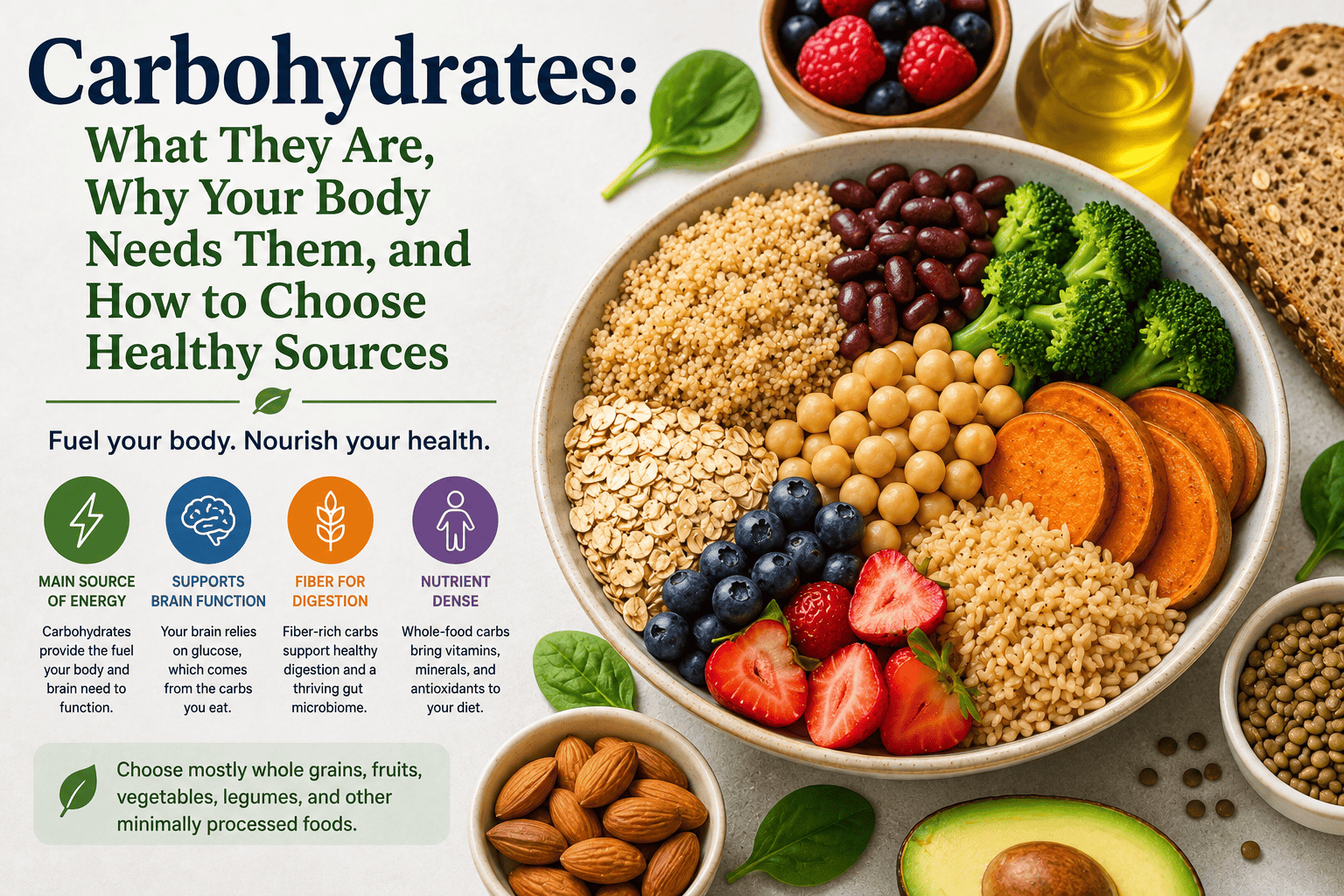
Carbohydrates: What They Are, Why Your Body Needs Them, and How to Choose Healthy Sources
Carbohydrates have become one of the most confusing topics in nutrition.
Depending on where you look, carbohydrates may be described as the body’s preferred source of energy—or as something you should avoid if you want to be healthy. Some diets encourage eating very few carbohydrates, while others emphasize grains, fruits, vegetables, and legumes as important parts of a balanced diet.
So what is the truth?
The answer is more nuanced than simply labeling carbohydrates as “good” or “bad.” Carbohydrates are an important source of energy, but the type and food source of the carbohydrate matter. A diet built around vegetables, fruits, legumes, and whole grains is very different from one dominated by sugary drinks, refined grains, and highly processed foods.
In this guide, we’ll look at what carbohydrates are, why your body needs them, the different types of carbohydrates, how much you need, and practical ways to choose better carbohydrate sources.
If you’re new to nutrition, you may also want to start with our guide [What Is Good Nutrition? A Practical Guide to a Balanced Diet] before diving deeper into individual nutrients.
What Are Carbohydrates?
Carbohydrates are one of the three major macronutrients, along with protein and fat.
They are found naturally in a wide variety of foods, including fruits, vegetables, grains, beans, lentils, milk, and some nuts and seeds. Carbohydrates are also added to many processed foods in the form of sugars and refined starches.
Your digestive system breaks down many carbohydrates into smaller molecules, including glucose. Glucose can then be used by cells throughout your body for energy.
This doesn’t mean that every carbohydrate-containing food affects your body in exactly the same way.
An apple, a bowl of oatmeal, a serving of lentils, and a sugary soft drink all contain carbohydrates, but they also contain very different combinations of fiber, vitamins, minerals, protein, water, and other compounds.
That’s why looking at the whole food, rather than carbohydrates in isolation, is so useful.
Why Does Your Body Need Carbohydrates?
Carbohydrates can provide a significant portion of the energy your body needs throughout the day.
Your brain and other tissues use glucose and other fuels for energy, and carbohydrate-containing foods can contribute readily available energy for everyday activities and exercise.
Carbohydrates can also be part of a nutrient-dense diet because many carbohydrate-rich foods provide much more than carbohydrate alone.
For example:
- Fruits provide carbohydrates along with fiber, vitamins, minerals, and plant compounds.
- Vegetables provide carbohydrates along with fiber and a wide range of micronutrients.
- Beans and lentils provide carbohydrates, fiber, protein, minerals, and other nutrients.
- Whole grains provide carbohydrates, fiber, vitamins, minerals, and other naturally occurring compounds.
This is one reason carbohydrate quality matters so much.
The World Health Organization recommends that carbohydrate intake come primarily from whole grains, vegetables, fruits, and pulses such as beans and lentils. Its guidance specifically emphasizes the quality of carbohydrate-containing foods rather than treating all carbohydrates as interchangeable.
The Three Main Types of Carbohydrates
Carbohydrates are commonly discussed as sugars, starches, and fiber.
1. Sugars
Sugars are relatively simple carbohydrates.
Some sugars occur naturally in foods. For example, fruit contains naturally occurring sugars, while milk contains the sugar lactose.
Other sugars are added to foods and beverages during processing or preparation.
Examples include:
- Table sugar
- Syrups
- Sugary beverages
- Candy
- Sweetened baked goods
- Many desserts
Naturally occurring sugars in foods such as fruit come packaged with other nutrients and, in the case of whole fruit, fiber.
Added sugars are a different matter. Foods and beverages high in added sugars can make it easier to consume large amounts of calories without providing much nutritional value.
That is one reason current nutrition guidance emphasizes choosing nutrient-dense foods and limiting foods high in added sugars.
2. Starches
Starches are complex carbohydrates made up of many linked sugar molecules.
Common sources include:
- Potatoes
- Corn
- Oats
- Rice
- Bread
- Pasta
- Beans
- Lentils
- Other grains
Again, the source matters.
A serving of beans or steel-cut oats provides a very different nutritional package from a highly refined carbohydrate food.
Refined grains have had parts of the grain removed during processing. Some refined grain products are enriched or fortified with certain nutrients, but they generally contain less fiber than comparable whole-grain foods.
Whole grains contain the grain’s bran, germ, and endosperm.
When possible, choosing whole grains can be an easy way to improve the nutritional quality of the carbohydrate-containing foods in your diet.
3. Dietary Fiber
Fiber is a type of carbohydrate that your body does not completely digest.
Instead of being broken down and absorbed like many other carbohydrates, much of the fiber passes through the digestive tract, where it can have important effects on digestion and the gut environment.
There are different types of fiber, and they can behave differently in the body.
Fiber can help support normal bowel function, contribute to feelings of fullness, and influence how quickly carbohydrates are digested and absorbed.
Some types of fiber are also fermented by microorganisms in the large intestine.
If you’d like to go deeper into this topic, read our article [Dietary Fiber: What It Is, Why You Need It, and How to Get More].
For most people, increasing fiber through whole foods is more useful than simply looking for products marketed as “high fiber.”
Good sources include:
- Beans and lentils
- Whole grains
- Vegetables
- Fruits
- Nuts
- Seeds
Are Carbohydrates Bad for You?
No.
The idea that carbohydrates as a category are inherently unhealthy is too simplistic.
A diet can contain carbohydrates and still be highly nutritious.
In fact, many foods that nutrition experts encourage people to eat regularly—such as vegetables, fruits, beans, lentils, and whole grains—contain carbohydrates.
The bigger question is which carbohydrate-containing foods make up most of your diet.
There is a substantial difference between getting carbohydrates primarily from vegetables, fruit, legumes, and whole grains and getting them primarily from sugary beverages, sweets, and highly refined foods.
The WHO’s carbohydrate guideline focuses heavily on this distinction, recommending that carbohydrate intake come primarily from whole grains, vegetables, fruits, and pulses.
What About Low-Carbohydrate Diets?
Low-carbohydrate diets can be useful in certain circumstances, and some people choose them as a dietary strategy.
However, “low carbohydrate” doesn’t automatically mean “healthy,” just as “higher carbohydrate” doesn’t automatically mean “unhealthy.”
The foods replacing carbohydrates matter.
For example, replacing highly refined carbohydrate foods with vegetables, legumes, nuts, seeds, and other nutrient-dense foods is very different from replacing a large portion of carbohydrate-containing foods with foods high in saturated fat and sodium.
The overall dietary pattern is important.
For that reason, it is usually more productive to ask:
What foods am I eating?
rather than simply:
How many carbohydrates am I eating?
If you are considering a major change in carbohydrate intake because of a medical condition, medication, pregnancy, or another individual health concern, it’s worth discussing that change with a qualified healthcare professional.
How Many Carbohydrates Do You Need?
There isn’t one carbohydrate target that is appropriate for every person.
Your carbohydrate needs can vary based on factors such as age, body size, activity level, total calorie needs, and overall dietary pattern.
The National Academies established an Acceptable Macronutrient Distribution Range (AMDR) of 45–65% of total energy from carbohydrate for adults. This is a population-level reference range, not a requirement that every individual must follow.
It’s also important not to confuse the AMDR with the number printed on a Nutrition Facts label.
The FDA currently lists a Daily Value of 275 grams of total carbohydrate per day, based on a 2,000-calorie diet. The FDA explicitly notes that an individual’s needs may be higher or lower depending on calorie requirements.
In other words, seeing “275 g” on a food label does not mean that every person should consume exactly 275 grams of carbohydrate every day.
How to Choose Healthier Carbohydrates
Rather than trying to eliminate carbohydrates, a more practical approach is to improve the quality of the carbohydrate-containing foods you eat.
Choose more whole grains
Try foods such as:
- Oatmeal
- Brown rice
- Barley
- Whole-grain bread
- Whole-grain pasta
- Quinoa
- Other minimally processed whole grains
When buying packaged grain products, check the ingredient list and nutrition label rather than relying solely on words such as “multigrain” or “wheat.”
Eat more fruits and vegetables
Whole fruits and vegetables are excellent sources of carbohydrate along with fiber and micronutrients.
Fresh, frozen, and canned options can all fit into a healthy diet. The WHO notes that frozen and canned fruits and vegetables can be good choices when they don’t contain excessive added sugars or sodium.
Whole fruit is generally preferable to fruit juice when you want to maximize fiber and reduce the concentration of free sugars.
Include beans and lentils
Beans, lentils, chickpeas, and other pulses are particularly useful because they provide a combination of carbohydrate, fiber, and protein.
They can work in everything from soups and salads to chili, grain bowls, and main dishes.
If you’re also interested in protein, see our guide [Protein: Why Your Body Needs It and How Much Do You Need?].
Pay attention to added sugars
You don’t need to avoid every food containing sugar.
Instead, pay attention to how often foods and beverages high in added sugars appear in your diet.
Sugary drinks are particularly easy to overlook because they can provide substantial amounts of sugar without providing the fiber and other nutrients found in whole foods.
Reading the Nutrition Facts label can help you identify both total sugars and added sugars.
How to Read Carbohydrates on a Nutrition Facts Label
The Nutrition Facts label lists Total Carbohydrate along with several components that contribute to that total.
These include:
- Dietary fiber
- Total sugars
- Added sugars
The FDA’s current Daily Value for total carbohydrate is 275 grams, while the Daily Value for dietary fiber is 28 grams on a 2,000-calorie reference diet.
The percentage Daily Value can also be useful for comparing foods.
The FDA gives a general rule of thumb that 5% DV or less is considered low and 20% DV or more is considered high for an individual nutrient.
But don’t use the label to judge a food based on carbohydrate grams alone.
For example, a food may contain a substantial amount of carbohydrate because it contains whole grains, fruit, or legumes. Those foods can still be valuable parts of a balanced diet.
Look at the entire label and consider the food itself.
What Does a Balanced Carbohydrate Plate Look Like?
A simple way to put all of this into practice is to build meals around a variety of nutrient-dense foods.
For example, a meal might include:
½ plate: vegetables and/or fruit
¼ plate: a protein food such as beans, fish, poultry, eggs, tofu, or another protein source
¼ plate: a carbohydrate-rich food such as brown rice, quinoa, potatoes, whole-grain pasta, or another whole grain
You can adjust those proportions based on your individual needs and preferences.
The important point isn’t creating a perfect plate at every meal. It’s creating a dietary pattern that regularly includes a wide variety of nutritious foods.
The Bottom Line
Carbohydrates aren’t something you need to fear.
They are one of the body’s major sources of dietary energy, and many carbohydrate-containing foods provide important fiber, vitamins, minerals, and other beneficial compounds.
The most useful distinction isn’t simply carbohydrate versus no carbohydrate.
It’s nutrient-dense carbohydrate-containing foods versus foods that provide large amounts of refined carbohydrate, added sugar, or calories with relatively little nutritional value.
For most people, a practical approach is to make foods such as vegetables, fruits, beans, lentils, and whole grains regular parts of the diet while keeping highly processed foods and foods high in added sugars in moderation.
And remember that carbohydrates are only one part of the bigger picture. Good nutrition comes from the overall pattern of foods you eat over time.
For the bigger picture, start with [What Is Good Nutrition? A Practical Guide to a Balanced Diet], then explore our articles on protein and dietary fiber and vitamins and minerals as you build your understanding of the major nutrients.
Sources
1. WHO — Carbohydrate intake for adults and children
3. FDA — Interactive Nutrition Facts Label: Total Carbohydrate
4. FDA — Daily Value on Nutrition and Supplement Facts Labels
5. National Academies — Acceptable Macronutrient Distribution Ranges