
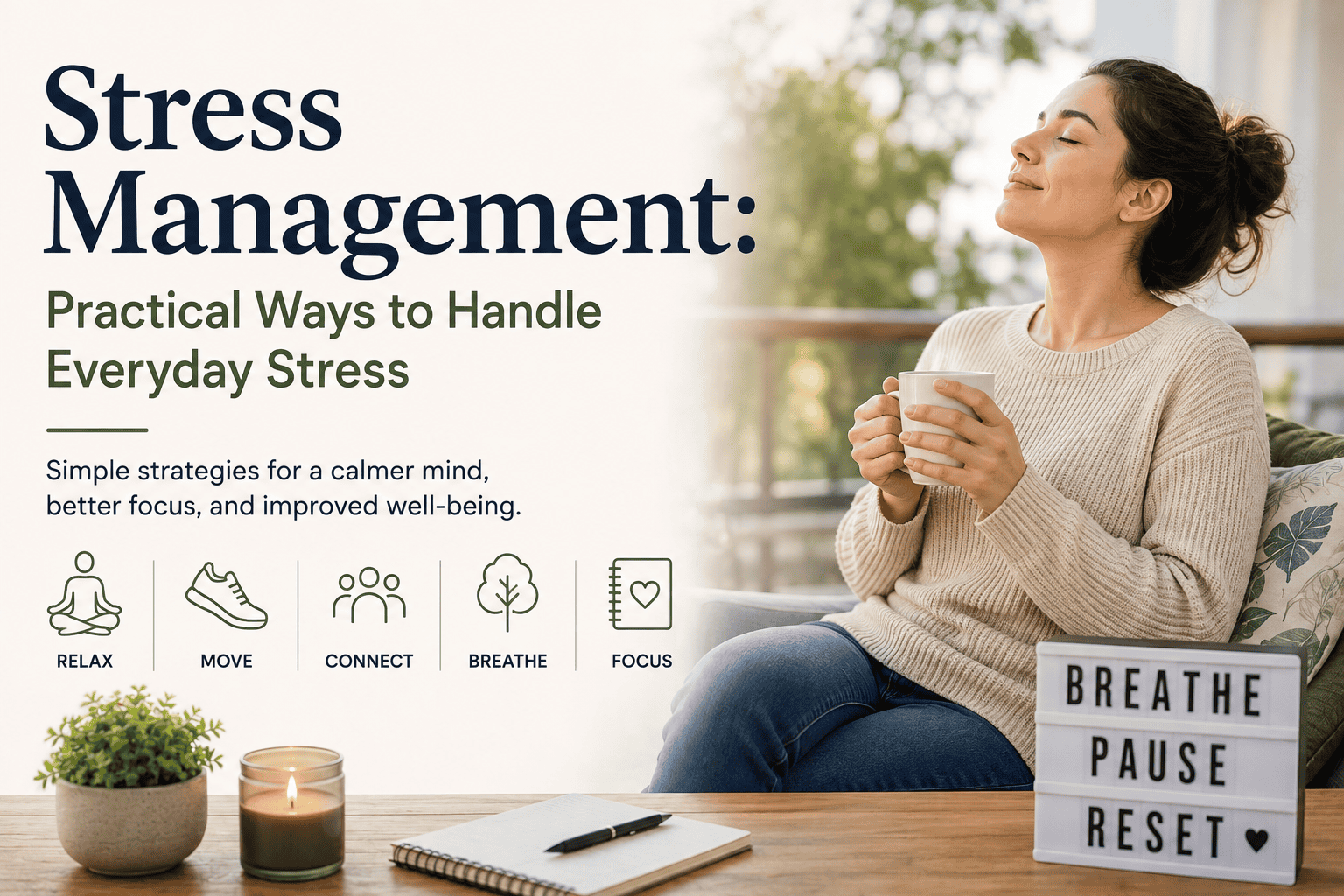
Stress Management: Practical Ways to Handle Everyday Stress
Stress is part of being human.
A busy day at work, a difficult conversation, financial concerns, family responsibilities, traffic, deadlines, health worries, or simply having too much to do can all create stress.
You can’t eliminate every stressful situation from your life—and trying to do so probably isn’t realistic.
The more useful goal is learning how to respond to stress in healthier ways and recover when stressful situations pass.
Some stress can actually be useful. It can help you pay attention, meet a deadline, respond to a challenge, or solve a problem. But when stress becomes frequent, intense, or persistent, it can begin to interfere with sleep, mood, concentration, relationships, and physical health.
The good news is that stress management doesn’t have to mean completely changing your life.
Small, consistent habits can make a meaningful difference.
This guide explains what stress is, how it affects your body, practical ways to manage everyday stress, and when it may be time to seek additional support.
What Is Stress?
Stress is your body’s physical and emotional response to a challenge or demand.
When your brain perceives a threat or difficult situation, your body can activate what is often called the fight-or-flight response.
Your heart rate and breathing may increase. Your muscles can tense. Your body releases hormones that help prepare you to respond.
This response can be extremely useful when you need to react quickly.
The problem isn’t that your body has a stress response.
The problem can occur when that response is activated repeatedly or remains elevated for long periods.
The National Center for Complementary and Integrative Health (NCCIH) describes occasional stress as a normal coping mechanism while noting that long-term stress can contribute to or worsen a range of health problems.
In other words, stress itself isn’t automatically bad.
How often it occurs, how intense it becomes, how long it lasts, and how well you recover all matter.
Is All Stress Bad?
No.
Some short-term stress can actually be helpful.
Imagine that you have an important presentation tomorrow.
A certain amount of pressure may motivate you to prepare, organize your thoughts, and focus.
The American Psychological Association (APA) explains that stress can be brief and situational and may sometimes motivate performance.
The problem develops when stress becomes chronic or begins interfering with your ability to function normally.
Chronic stress can contribute to problems such as:
- Difficulty sleeping
- Irritability
- Trouble concentrating
- Headaches
- Muscle tension
- Digestive problems
- Changes in appetite
- Fatigue
- Anxiety or low mood
- Worsening of existing health problems
The CDC’s guidance on managing stress similarly notes that long-term stress can contribute to worsening health problems.
The goal isn’t to live a completely stress-free life.
It’s to develop healthier ways to handle the stress that inevitably occurs.
How Does Stress Affect Your Body?
Stress isn’t just something you “feel.”
It produces physical changes throughout the body.
The APA explains that stress can affect multiple body systems, including the cardiovascular, respiratory, gastrointestinal, musculoskeletal, nervous, and endocrine systems.
You may notice this during a stressful moment.
Your shoulders tighten.
Your heart beats faster.
Your stomach feels unsettled.
Your breathing changes.
You may find yourself sweating or feeling restless.
These reactions are part of the body’s normal stress response.
Once the stressful situation passes, your body should gradually return toward its normal state.
The concern is when stressful situations occur so frequently that your body has less opportunity to recover.
What Is Chronic Stress?
Chronic stress is stress that continues for an extended period of time.
It can come from ongoing circumstances such as:
- Financial difficulties
- Relationship problems
- Work-related pressure
- Caregiving responsibilities
- Long-term health concerns
- Major life changes
- Persistent uncertainty
- Difficult living circumstances
Sometimes the source of chronic stress is obvious.
Other times, it’s the accumulation of many smaller pressures.
One frustrating email probably isn’t a major health concern.
But dozens of small stressors every day, combined with poor sleep, little physical activity, inadequate recovery, and no time to decompress, can eventually leave you feeling overwhelmed.
The APA notes that chronic stress can affect both physical and psychological well-being.
That’s why stress management is better thought of as an ongoing health habit than a technique you use only when you’re already overwhelmed.
Why You Shouldn’t Try to Eliminate All Stress
It may sound appealing to eliminate stress completely.
But that’s not realistic.
You will encounter difficult people, unexpected problems, deadlines, disappointments, and changes throughout your life.
A healthier goal is resilience.
Resilience doesn’t mean never feeling stressed.
It means developing the ability to adapt, recover, and keep moving forward when life becomes difficult.
This changes the question from:
“How can I avoid stress?”
to:
“How can I respond to stress more effectively?”
That shift can make stress management much more practical.
1. Start by Identifying Your Stress Triggers
One of the most useful first steps is figuring out what actually causes your stress.
Stress can become so familiar that you don’t notice the pattern until you’re already overwhelmed.
For a week or two, pay attention to situations that consistently leave you feeling tense, frustrated, worried, or exhausted.
You might notice patterns involving:
- Work
- Social media
- News
- Money
- Lack of sleep
- Certain relationships
- Too many commitments
- Clutter or disorganization
- Lack of exercise
- Constant notifications
- Not having enough time alone
You don’t need to keep an elaborate journal.
Simply noticing patterns can help.
The National Institute of Mental Health (NIMH) recommends identifying stressors and learning which coping strategies work for you.
Once you know what’s triggering stress, you can begin deciding which parts you can change and which parts you simply need to learn to manage.
2. Separate Problems You Can Control From Problems You Can’t
This is one of the simplest ways to reduce unnecessary mental strain.
Some problems are within your control.
For example:
- How you organize your schedule
- Whether you exercise
- How much news you consume
- Whether you ask for help
- When you go to bed
- How you respond to an argument
Other things aren’t.
You can’t control:
- Other people’s opinions
- The weather
- Every traffic delay
- Unexpected events
- Everything that happens at work
- The past
When you’re stressed, it can be tempting to spend enormous amounts of mental energy trying to solve things you don’t actually control.
Instead, ask:
“Is there something I can do about this right now?”
If the answer is yes, identify the next practical step.
If the answer is no, your next step may be accepting that uncertainty and redirecting your attention toward something you can influence.
3. Take Short Breaks During the Day
Stress can build when you move continuously from one demand to another without giving yourself any time to reset.
You don’t need a 30-minute meditation session to take a break.
Even a few minutes can provide a useful transition.
Try:
- Standing up and stretching
- Taking several slow breaths
- Walking outside
- Looking away from your screen
- Getting a glass of water
- Sitting somewhere quiet
- Listening to calming music
- Stepping away from your phone
The CDC recommends taking breaks from work and news as part of healthy stress management.
The point isn’t to escape your responsibilities.
It’s to give your mind a short period without another demand being placed on it.
4. Try Slow, Controlled Breathing
When you’re stressed, your breathing can become faster or shallower.
Slowing your breathing can be a simple way to create a brief pause between the stressful situation and your response.
The APA’s stress-management tools include slow breathing as one practical technique for reducing physiological arousal.
You don’t need a complicated breathing method.
Try this:
Breathe in slowly.
Pause briefly.
Exhale slowly and comfortably.
Repeat for several breaths.
The goal isn’t to force yourself to feel completely calm.
You’re simply giving your body a few moments of slower, more controlled breathing.
5. Move Your Body
Physical activity is one of the most useful tools for managing stress.
Exercise doesn’t make stressful circumstances disappear, but regular movement can support physical and emotional well-being.
Walking is an especially accessible option.
A short walk can give you a change of scenery, interrupt a stressful workday, and provide an opportunity to step away from whatever has been occupying your attention.
You don’t need to wait until you have time for a full workout.
A 10- or 20-minute walk is still movement.
Our article Physical Activity: How Much Exercise Do You Really Need? covers the current physical activity recommendations and practical ways to become more active.
For stress management, consistency matters more than having the perfect workout.
6. Protect Your Sleep
Stress and sleep can easily become a cycle.
Stress makes it harder to sleep.
Poor sleep makes it harder to handle stress the next day.
The CDC recommends getting enough sleep as part of healthy stress management, and adults generally need at least seven hours per night.
Our article Sleep and Your Health: Why Quality Sleep Matters explores the relationship between sleep, recovery, mood, and overall health in greater detail.
If stress is keeping you awake, don’t assume that sacrificing sleep is the solution.
Giving your body enough opportunity to recover may actually make stressful situations easier to handle.
7. Pay Attention to Caffeine and Alcohol
When you’re stressed, it’s tempting to reach for something that provides immediate relief.
For many people, that means caffeine during the day or alcohol at night.
Neither automatically represents a problem.
But if you’re relying heavily on caffeine to compensate for poor sleep, or using alcohol regularly to unwind, it may be worth looking at the larger pattern.
Caffeine can interfere with sleep when consumed too close to bedtime, which can then make stress harder to manage the following day.
Alcohol may make you feel relaxed initially but can interfere with sleep quality.
A better long-term strategy is to build several ways to decompress so that no single substance becomes your primary coping mechanism.
8. Create a Transition Between Work and Home
Modern technology makes it possible to stay connected to work almost constantly.
That can make it difficult for your brain to recognize that the workday has ended.
Creating a transition can help.
For example:
- Take a short walk after work
- Change clothes when you get home
- Spend 10 minutes outside
- Listen to music during your commute
- Put work notifications on silent
- Write down tomorrow’s priorities before leaving work
- Avoid checking work email during your evening
The specific ritual doesn’t matter as much as creating a clear boundary.
You’re teaching yourself:
Work is finished for today. Now it’s time to shift into another part of life.
9. Limit Constant News and Social Media Exposure
Staying informed is valuable.
But constantly consuming stressful information can leave your nervous system with very little downtime.
The CDC recommends taking breaks from news and social media as part of healthy stress management.
Try setting specific times to check the news rather than keeping it available continuously.
You can also:
- Turn off unnecessary notifications
- Unfollow accounts that consistently make you feel distressed
- Avoid doomscrolling before bed
- Take occasional social media breaks
- Choose a few trustworthy sources rather than constantly checking multiple feeds
You don’t have to disconnect from the world.
You simply need to create periods when your attention isn’t being pulled toward another alarming headline or notification.
10. Spend Time With People You Trust
Social connection can be an important part of coping with stress.
Talking with someone you trust doesn’t necessarily solve the problem.
Sometimes simply being able to say, “This has been a really difficult week,” can make the experience feel less isolating.
The CDC recommends connecting with people you trust and with community networks as part of healthy coping.
That might mean:
- Calling a friend
- Having dinner with family
- Taking a walk with someone
- Joining a community group
- Volunteering
- Participating in a hobby group
- Talking with someone who understands what you’re experiencing
Healthy social connection doesn’t require a huge social circle.
A few meaningful relationships can be extremely valuable.
11. Spend Time Outdoors
Getting outside can provide several useful benefits at once.
You may get natural light, move your body, change your environment, and temporarily step away from screens and responsibilities.
You don’t need to hike through a forest.
Try:
- Walking around your neighborhood
- Sitting in a park
- Gardening
- Eating lunch outside
- Taking a short walk during a break
- Spending time in your yard
The CDC includes spending time outdoors among healthy ways to cope with stress.
Sometimes changing your physical environment is enough to interrupt a stressful mental loop.
12. Make Time for Things You Actually Enjoy
Stress management isn’t supposed to be another item on your to-do list.
Enjoyment matters.
Make time for activities that aren’t primarily about productivity.
That could be:
- Reading
- Gardening
- Cooking
- Music
- Art
- Sports
- Hiking
- Spending time with friends
- Playing with your dog
- Watching a favorite show
- Working on a hobby
The APA recommends making time for enjoyable activities as part of managing the effects of chronic stress.
You don’t have to justify every enjoyable activity by making it “productive.”
Sometimes relaxing and having fun is exactly what your brain needs.
13. Try Journaling
Writing things down can help organize thoughts that otherwise keep circling through your mind.
You don’t need to write pages every night.
Try answering three questions:
What is stressing me right now?
What can I actually do about it?
What can wait until tomorrow?
This can help turn vague worry into something more concrete.
The NIMH includes journaling among activities people can try when they feel overwhelmed.
If traditional journaling doesn’t appeal to you, a simple notes app or a few bullet points can accomplish the same basic purpose.
14. Practice Gratitude Without Forcing Positivity
Gratitude can be useful, but it shouldn’t become a way of dismissing legitimate problems.
You don’t have to tell yourself everything is wonderful when it isn’t.
Instead, look for something specific that went well.
Maybe:
- Someone helped you.
- You had a good conversation.
- You got outside.
- You finished something difficult.
- You enjoyed a meal.
- You had a quiet moment.
- Someone made you laugh.
The CDC recommends practicing gratitude as one possible healthy coping strategy.
The goal isn’t forced positivity.
It’s giving your attention an opportunity to notice something besides whatever is currently going wrong.
15. Break Large Problems Into Smaller Steps
Stress often becomes worse when a problem feels too large to solve.
Instead of asking:
“How am I going to fix all of this?”
Ask:
“What’s the next thing I can do?”
For example, if you’re overwhelmed by a messy financial situation, the first step might simply be gathering your bills.
If you’re overwhelmed by work, the first step might be writing down everything that needs to be done.
If your house feels chaotic, clean one room—or even one surface.
Small actions can create a sense of progress and control.
You don’t have to solve everything today.
16. Don’t Expect One Technique to Work for Everything
There’s no universal stress-management technique.
Deep breathing might help one person.
Another person may find that walking works better.
Someone else might benefit most from talking with a friend.
The NIMH emphasizes that finding effective coping techniques can involve some trial and error.
That’s normal.
Think of stress management as building a toolbox, not finding one magical solution.
Your toolbox might include:
- Exercise
- Sleep
- Breathing exercises
- Time outdoors
- Social connection
- Journaling
- Music
- Hobbies
- Meditation
- Taking breaks
- Professional support
The more options you have, the less likely you are to depend on one coping strategy.
What About Meditation and Mindfulness?
Meditation and mindfulness can be useful tools for some people.
Mindfulness generally involves intentionally paying attention to the present moment rather than automatically getting pulled into thoughts about the past or future.
You don’t need to meditate for an hour.
A few minutes of sitting quietly and noticing your breathing, sounds, or physical sensations can be a reasonable place to begin.
The NCCIH’s information on stress discusses relaxation responses and approaches that can help counter the body’s stress response.
If meditation doesn’t appeal to you, that’s okay.
You don’t have to meditate to manage stress effectively.
What If Your Stress Is Coming From Something You Can’t Change?
This is one of the hardest parts of stress management.
Sometimes the stressful situation is real and ongoing.
You may not be able to change a difficult job, family situation, financial circumstance, social connections, or health problem immediately.
In these cases, stress management isn’t about pretending the problem doesn’t exist.
It’s about supporting yourself while you work through it.
Ask:
What can I control today?
Maybe you can:
- Set a boundary
- Ask for help
- Make a plan
- Take care of your sleep
- Exercise
- Talk to someone
- Learn more about your options
- Take one practical step
You don’t have to solve an entire life problem in one day.
When Stress Becomes Too Much
Everyone feels stressed sometimes.
But stress deserves more attention when it becomes persistent, overwhelming, or begins interfering with everyday life.
The NIMH recommends seeking additional help when stress symptoms interfere with daily life, cause you to avoid activities, or seem to be constantly present.
Consider talking with a healthcare professional or mental health professional if:
- You feel overwhelmed most of the time
- Stress is interfering with work or relationships
- You regularly can’t sleep because of stress
- You’re experiencing persistent anxiety or low mood
- You are withdrawing from activities you normally enjoy
- You’re using alcohol or drugs to cope
- Physical symptoms are becoming persistent
- You feel unable to manage everyday responsibilities
Seeking help isn’t a sign that you’ve failed at managing stress.
Sometimes the healthiest response is recognizing that you don’t have to handle everything alone.
What If You’re in Immediate Emotional Crisis?
If stress has reached the point where you are thinking about harming yourself, feel unable to stay safe, or are experiencing an immediate mental health crisis, seek urgent help rather than trying to manage it on your own.
In the United States, you can call or text 988 to reach the Suicide & Crisis Lifeline.
If you’re in immediate danger, call emergency services or go to the nearest emergency department.
Stress management techniques are useful for everyday stress.
They aren’t a substitute for emergency care when someone is in crisis.
A Simple Daily Stress-Management Routine
You don’t need to completely redesign your life.
Here’s a simple starting point:
Morning
Get some natural light and move your body for a few minutes.
During the workday
Take short breaks instead of working continuously for hours.
Afternoon
Pay attention to caffeine timing and take a few minutes away from your screen.
After work
Create a transition between work and personal time.
Evening
Reduce stimulating news and social media, eat a balanced meal, and make time for something enjoyable.
Before bed
Give yourself time to wind down and prioritize adequate sleep.
This isn’t a prescription.
It’s simply an example of how small stress-management habits can fit into an ordinary day.
The Bigger Picture
Stress management works best when it’s part of a broader healthy lifestyle.
Sleep matters.
Physical activity matters.
Nutrition matters.
Social connection matters.
So does having time to rest and enjoy your life.
Our Healthy Living guide brings these different pieces together as part of a practical approach to everyday wellness.
Our Sleep and Your Health article explores the connection between sleep and recovery, while Physical Activity: How Much Exercise Do You Really Need? covers the role of regular movement.
You don’t have to perfect every area at once.
In fact, trying to completely overhaul your life can become another source of stress.
Instead, choose one or two changes that feel realistic.
Take a walk.
Go to bed a little earlier.
Turn off unnecessary notifications.
Call someone you trust.
Spend ten minutes outside.
Take a few slow breaths.
Write down what’s bothering you and identify the next step.
Small actions may not eliminate the stressful parts of life.
But they can help you become better equipped to handle them.
The Bottom Line
Stress is a normal part of life.
The goal isn’t to eliminate it completely.
The goal is to recognize when stress is building, understand what triggers it, and develop healthy ways to respond and recover.
Regular movement, adequate sleep, time outdoors, social connection, relaxation techniques, enjoyable activities, healthy routines, and taking breaks from constant information can all become part of your personal stress-management toolbox.
And if stress becomes persistent or starts interfering with your everyday life, don’t feel like you have to manage it alone.
Healthy living isn’t about creating a life without stress. It’s about building habits and support systems that help you navigate stressful moments without letting them take over your life.
Sources
- CDC — Managing Stress:Managing Stress — CDC
- NIMH — I’m So Stressed Out! Fact Sheet:I’m So Stressed Out! — NIMH
- NIH/NCCIH — Stress:Stress — NCCIH
- APA — How Stress Affects Your Health:How Stress Affects Your Health — APA
- APA — Stress Effects on the Body:Stress Effects on the Body — APA
- APA — Stress Management Tools:Stress Management Tools — APA
- CDC — Stay Calm / Healthy Ways to Cope:Stay Calm — CDC