
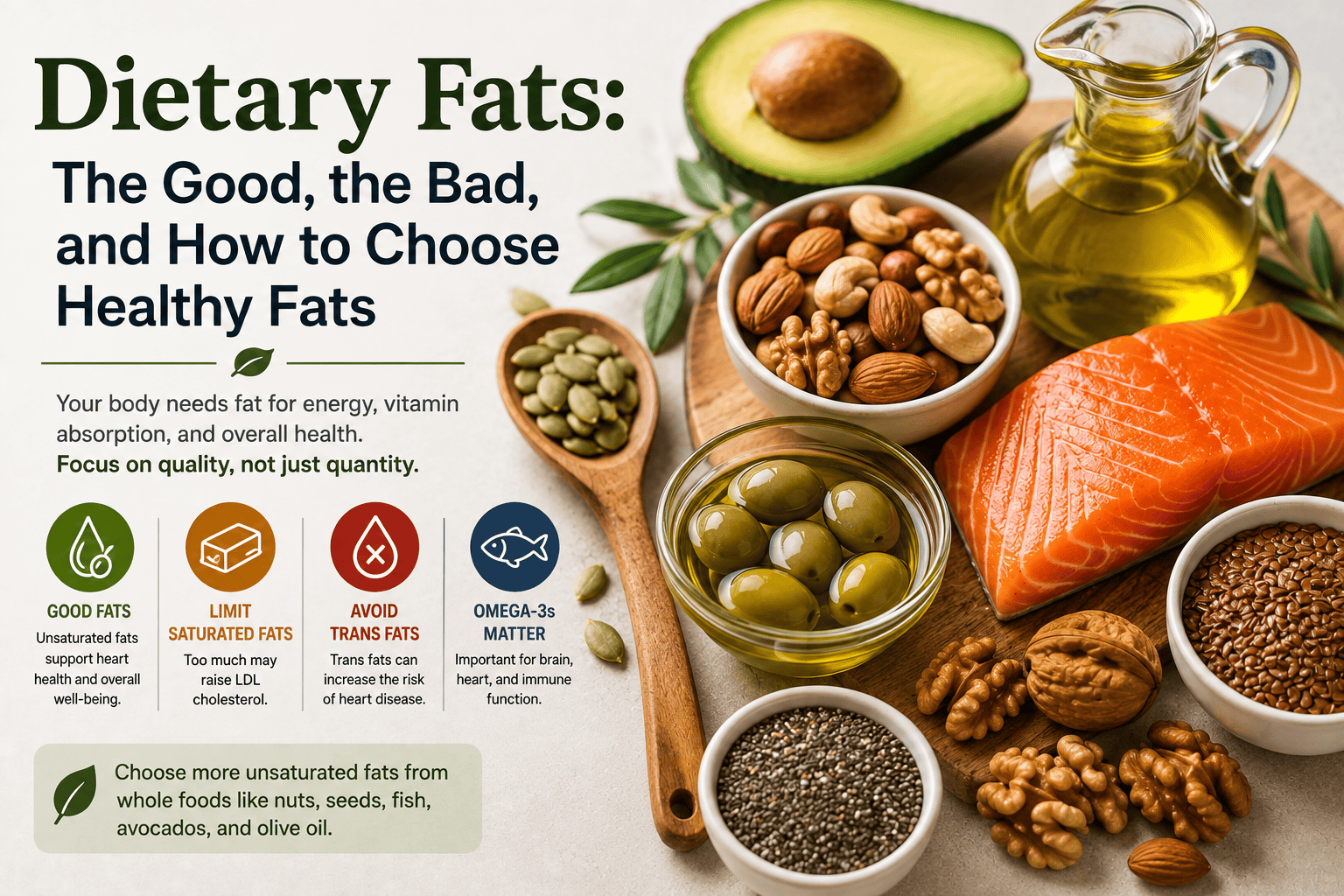
Dietary Fats: The Good, the Bad, and How to Choose Healthy Fats
Fat has had a complicated reputation in nutrition.
For years, dietary fat was often treated as something to avoid. Today, we have a much better understanding of how different types of fat affect the body. Fat is an essential nutrient, and the goal isn’t to eliminate it from your diet. Instead, it is to understand which fats to prioritize, which to limit, and how they fit into an overall healthy eating pattern.
Dietary fats provide energy, help your body absorb certain vitamins, and supply essential fatty acids that your body cannot produce on its own. But different types of fat can have very different effects on health.
This guide explains the basics of dietary fat and offers practical ways to make healthier choices without becoming overly focused on numbers or restrictive food rules.
What Is Dietary Fat?
Dietary fat is one of the three major macronutrients, along with protein and carbohydrates.
Like protein and carbohydrates, fat provides energy. Fat also plays several important structural and biological roles throughout the body.
According to the National Academies of Sciences, Engineering, and Medicine, dietary fat is an important source of energy and helps the body absorb fat-soluble vitamins such as vitamins A, D, E, and K.
Fat also contributes to the structure of cell membranes and provides essential fatty acids that the body cannot make itself.
So, despite the reputation that fat has sometimes received, your body needs dietary fat.
The more useful question is: What types of fat are you eating most often?
Why Does Your Body Need Fat?
Dietary fat performs several important functions.
1. Fat provides energy
Fat is an energy-dense nutrient, providing about 9 calories per gram compared with approximately 4 calories per gram from protein and carbohydrates.
That doesn’t automatically make high-fat foods unhealthy. It simply means that relatively small amounts of fat contain a significant amount of energy.
2. Fat helps your body absorb certain vitamins
Vitamins A, D, E, and K are fat-soluble vitamins.
That means dietary fat helps your body absorb these vitamins from food.
This is one reason why completely eliminating fat from meals isn’t a good general nutrition strategy.
For example, adding a small amount of healthy fat to a meal containing vegetables can help your body absorb fat-soluble nutrients and other beneficial compounds.
3. Fat provides essential fatty acids
Some fatty acids are considered essential because your body cannot make them in sufficient amounts.
Two important essential fatty acids are:
- Linoleic acid (omega-6)
- Alpha-linolenic acid, or ALA (omega-3)
The National Academies established adequate intake values for these essential fatty acids.
Omega-3 fatty acids are also found in foods such as fatty fish, flaxseed, chia seeds, walnuts, and certain plant oils. The NIH Office of Dietary Supplements explains that ALA is an essential omega-3 fatty acid, while EPA and DHA are longer-chain omega-3s found primarily in seafood.
The Four Main Types of Dietary Fat
Not all dietary fats are the same.
The major categories you’ll encounter are:
- Monounsaturated fats
- Polyunsaturated fats
- Saturated fats
- Trans fats
Understanding these categories is much more useful than simply thinking of foods as “fatty” or “low-fat.”
1. Unsaturated Fats
Unsaturated fats include monounsaturated fats and polyunsaturated fats.
These fats are generally the ones nutrition experts encourage people to emphasize in place of saturated fats.
The American Heart Association recommends replacing foods high in saturated and trans fats with foods containing monounsaturated and polyunsaturated fats.
Foods rich in unsaturated fats include:
- Olive oil
- Canola oil
- Avocados
- Nuts
- Seeds
- Fatty fish
- Soybeans and soy products
- Some other plant oils
These foods can fit naturally into a balanced dietary pattern.
Monounsaturated Fats
Monounsaturated fats are found in foods such as:
- Olive oil
- Avocados
- Peanuts and peanut butter
- Almonds
- Cashews
- Many other nuts and seeds
One practical advantage of monounsaturated-fat-rich foods is that they can make meals more satisfying while also providing other nutrients.
For example, an avocado provides fat along with fiber and other nutrients. Nuts provide fat along with protein, fiber, vitamins, and minerals.
This is an important concept in nutrition:
The food containing the fat matters, not just the fat itself.
Polyunsaturated Fats
Polyunsaturated fats include the essential fatty acids mentioned earlier.
They include both omega-3 and omega-6 fatty acids.
Sources include:
- Fatty fish
- Walnuts
- Flaxseed
- Chia seeds
- Soybeans
- Sunflower seeds
- Certain vegetable oils
Omega-3 fatty acids are particularly well known because of their roles in cell membranes and the cardiovascular, immune, nervous, and endocrine systems.
The NIH Office of Dietary Supplements provides a detailed overview of omega-3 fatty acids, including their food sources and current evidence regarding health effects.
2. Saturated Fat
Saturated fats occur naturally in many foods.
Common sources include:
- Butter
- Cheese
- Full-fat dairy
- Fatty cuts of meat
- Poultry with skin
- Lard
- Coconut oil
- Palm oil
- Many processed foods
The issue isn’t that eating a food containing saturated fat automatically makes that food unhealthy.
Rather, regularly consuming large amounts of saturated fat can raise LDL cholesterol, and replacing saturated fat with unsaturated fat can improve the overall cardiovascular profile of the diet.
The American Heart Association recommends limiting saturated fat and emphasizes replacing it with healthier unsaturated fat sources.
For people who need about 2,000 calories per day, the AHA recommends keeping saturated fat below 6% of total calories, or approximately 13 grams per day.
That is a general heart-health recommendation rather than a universal prescription for every individual.
3. Trans Fat
Trans fats are the type of dietary fat that deserves the strongest “avoid when possible” message.
Artificial trans fats were historically created through a process called partial hydrogenation, which made liquid oils more solid and shelf-stable.
These fats were commonly used in some processed foods and baked goods.
Fortunately, the use of industrial trans fats has declined dramatically, and partially hydrogenated oils have largely been removed from the U.S. food supply.
The American Heart Association recommends avoiding trans fats.
When looking at packaged foods, checking the ingredient list for “partially hydrogenated oils” can still be useful.
What About Omega-3 Fatty Acids?
Omega-3 fatty acids deserve special attention because they are an important part of a healthy diet.
The three omega-3s most commonly discussed are:
- ALA — alpha-linolenic acid
- EPA — eicosapentaenoic acid
- DHA — docosahexaenoic acid
ALA is primarily found in plant foods such as flaxseed, chia seeds, walnuts, and certain plant oils.
EPA and DHA are found primarily in seafood.
Your body can convert some ALA into EPA and DHA, but the conversion is limited. The NIH Office of Dietary Supplements explains that getting EPA and DHA directly from foods such as seafood is the practical way to increase their levels in the body.
Good food sources of omega-3s include:
- Salmon
- Sardines
- Mackerel
- Herring
- Trout
- Flaxseed
- Chia seeds
- Walnuts
- Canola oil
- Soybean oil
For most people, food is the best place to start rather than immediately turning to a supplement.
Are All High-Fat Foods Unhealthy?
No.
This is one of the most important ideas to understand about dietary fat.
A food can be relatively high in fat and still be an excellent part of a healthy diet.
Consider foods such as:
- Avocados
- Nuts
- Seeds
- Olive oil
- Fatty fish
These foods contain substantial amounts of fat, but they also provide other nutrients and can fit into a healthy dietary pattern.
This is why focusing on the overall food and dietary pattern is generally more useful than labeling individual nutrients as simply “good” or “bad.”
What About Butter, Coconut Oil, and Olive Oil?
These foods are often compared in nutrition discussions, but they are not nutritionally identical.
Olive oil
Olive oil is rich in monounsaturated fat and is a practical choice for cooking, dressings, and other meals.
Butter
Butter contains a substantial amount of saturated fat, so it is generally better used in moderation rather than as the primary added fat in the diet.
Coconut oil
Coconut oil is sometimes marketed as a health food because it is plant-based. However, it is very high in saturated fat.
The American Heart Association recommends choosing unsaturated plant oils over tropical oils such as coconut and palm oil when possible.
The AHA’s guidance on healthy cooking oils provides practical comparisons among common cooking oils.
How Much Fat Should You Eat?
There isn’t one ideal amount of dietary fat that applies to every person.
Your needs depend on factors such as:
- Age
- Energy needs
- Activity level
- Overall dietary pattern
- Health conditions
- Individual nutritional requirements
Instead of trying to eliminate fat or hit a perfect number every day, a better strategy for many people is to focus on fat quality.
In other words:
Choose more unsaturated fats and limit saturated and trans fats.
The American Heart Association’s 2026 dietary guidance emphasizes a broader dietary pattern built around vegetables and fruits, whole grains, healthy protein sources, minimally processed foods, and unsaturated fats in place of saturated fats.
Simple Ways to Eat More Healthy Fats
You don’t need to completely change your diet to improve the quality of your fat intake.
Try a few simple swaps.
Instead of butter every time you cook:
Try olive or canola oil.
Instead of chips or highly processed snacks:
Try a small handful of nuts.
Instead of a processed meat-heavy meal:
Try fish, beans, lentils, or another protein source.
Instead of a creamy high-saturated-fat dressing:
Try an olive-oil-based vinaigrette.
Instead of avoiding fat from vegetables:
Pair vegetables with a source of healthy fat.
These aren’t rules. They’re simply examples of how small substitutions can shift the overall balance of your diet.
A Simple Way to Think About Dietary Fat
If you remember only a few things from this article, remember these:
1. Your body needs fat.
Fat provides energy, helps absorb fat-soluble vitamins, supports cell structures, and supplies essential fatty acids.
2. Not all fats have the same effects.
Unsaturated fats are generally preferable to saturated fats, while trans fats should be avoided whenever possible.
3. Food quality matters.
A food shouldn’t automatically be considered unhealthy just because it contains fat.
4. Think substitution, not elimination.
Replacing some saturated-fat-rich foods with foods containing unsaturated fats is more useful than simply trying to eat as little fat as possible.
5. Build your diet around foods, not individual nutrients.
Nuts, seeds, avocados, fish, vegetables, fruits, whole grains, legumes, and other minimally processed foods can work together as part of a balanced eating pattern.
How Dietary Fat Fits Into a Balanced Diet
Dietary fat is just one piece of the larger nutrition picture.
As we’ve discussed in our articles on what good nutrition looks like and protein and why your body needs it, a healthy diet isn’t built around one nutrient.
It is built around a variety of nutrient-dense foods that provide protein, carbohydrates, healthy fats, vitamins, minerals, fiber, and other beneficial compounds.
And as we discussed in our article on carbohydrates and how to choose healthy sources, the quality of the foods providing a nutrient often matters just as much as the nutrient itself.
The goal isn’t perfection.
It’s building a pattern of eating that is nutritious, practical, and sustainable.
Frequently Asked Questions
Is dietary fat bad for you?
No. Dietary fat is an essential nutrient with important roles in energy, vitamin absorption, cell structure, and essential fatty acid supply. The type and overall amount of fat matter.
What are the healthiest sources of dietary fat?
Good options include nuts, seeds, avocados, olive oil, other non-tropical plant oils, and fatty fish. These foods are generally rich in unsaturated fats.
Should I avoid saturated fat completely?
Not necessarily. Saturated fat occurs naturally in many foods. The general recommendation is to limit it and replace some saturated-fat-rich foods with sources of unsaturated fat.
Is olive oil healthier than butter?
Olive oil is generally higher in unsaturated fat, while butter is high in saturated fat. Replacing some butter with olive oil can therefore be a useful dietary swap.
Do I need an omega-3 supplement?
Not necessarily. Many people can obtain omega-3 fatty acids through foods such as fatty fish, walnuts, flaxseed, and chia seeds. Whether supplementation is appropriate depends on individual circumstances.
Sources
- National Academies of Sciences, Engineering, and Medicine — Dietary Reference Intakes: The Essential Guide to Nutrient Requirements
https://nap.nationalacademies.org/catalog/11537/dietary-reference-intakes-the-essential-guide-to-nutrient-requirements - American Heart Association — Fats in Foods
https://www.heart.org/en/healthy-living/healthy-eating/eat-smart/fats/fats-in-foods - American Heart Association — Saturated Fats
https://www.heart.org/en/healthy-living/healthy-eating/eat-smart/fats/saturated-fats - American Heart Association — Healthy Cooking Oils
https://www.heart.org/en/healthy-living/healthy-eating/eat-smart/fats/healthy-cooking-oils - American Heart Association — 2026 Dietary Guidance to Improve Cardiovascular Health
https://professional.heart.org/en/science-news/2026-dietary-guidance-to-improve-cardiovascular-health/top-things-to-know - NIH Office of Dietary Supplements — Omega-3 Fatty Acids Fact Sheet for Consumers
https://ods.od.nih.gov/factsheets/Omega3FattyAcids-Consumer/ - NIH Office of Dietary Supplements — Omega-3 Fatty Acids Fact Sheet for Health Professionals
https://ods.od.nih.gov/factsheets/Omega3FattyAcids-HealthProfessional/