How Digestion Works: From Your First Bite to Nutrient Absorption
Have you ever wondered what actually happens to your food after you swallow it?
Digestion is a remarkably coordinated process. Your digestive system takes the foods and drinks you consume, breaks them down into smaller components, absorbs useful nutrients and water, and moves the remaining waste through the body.
It doesn’t happen in one place, either. Your mouth, esophagus, stomach, small intestine, large intestine, liver, pancreas, gallbladder, nerves, hormones, and even the microorganisms living in your digestive tract all play different roles.
Understanding how digestion works makes it easier to understand many of the other topics we discuss here at Calm Health Lab — from gut health and fiber to the gut microbiome and nutrition.
Let’s follow a meal through the digestive system from beginning to end.
What Is Digestion?
Digestion is the process your body uses to break food down into smaller substances that can be absorbed and used.
The three major macronutrients — carbohydrates, proteins, and fats — all need to be broken down during digestion.
- Carbohydrates are broken down into simple sugars.
- Proteins are broken down into amino acids.
- Fats are broken down into fatty acids and glycerol.
Your body can then absorb these smaller components and use them for energy, growth, maintenance, and cell repair.
The National Institute of Diabetes and Digestive and Kidney Diseases (NIDDK) explains that digestion involves both physical movement — such as chewing and the muscular contractions that move food through the digestive tract — and digestive juices containing substances such as stomach acid, bile, and enzymes.
So digestion isn’t simply “food going through your stomach.” It’s a coordinated process involving multiple organs and chemical reactions.
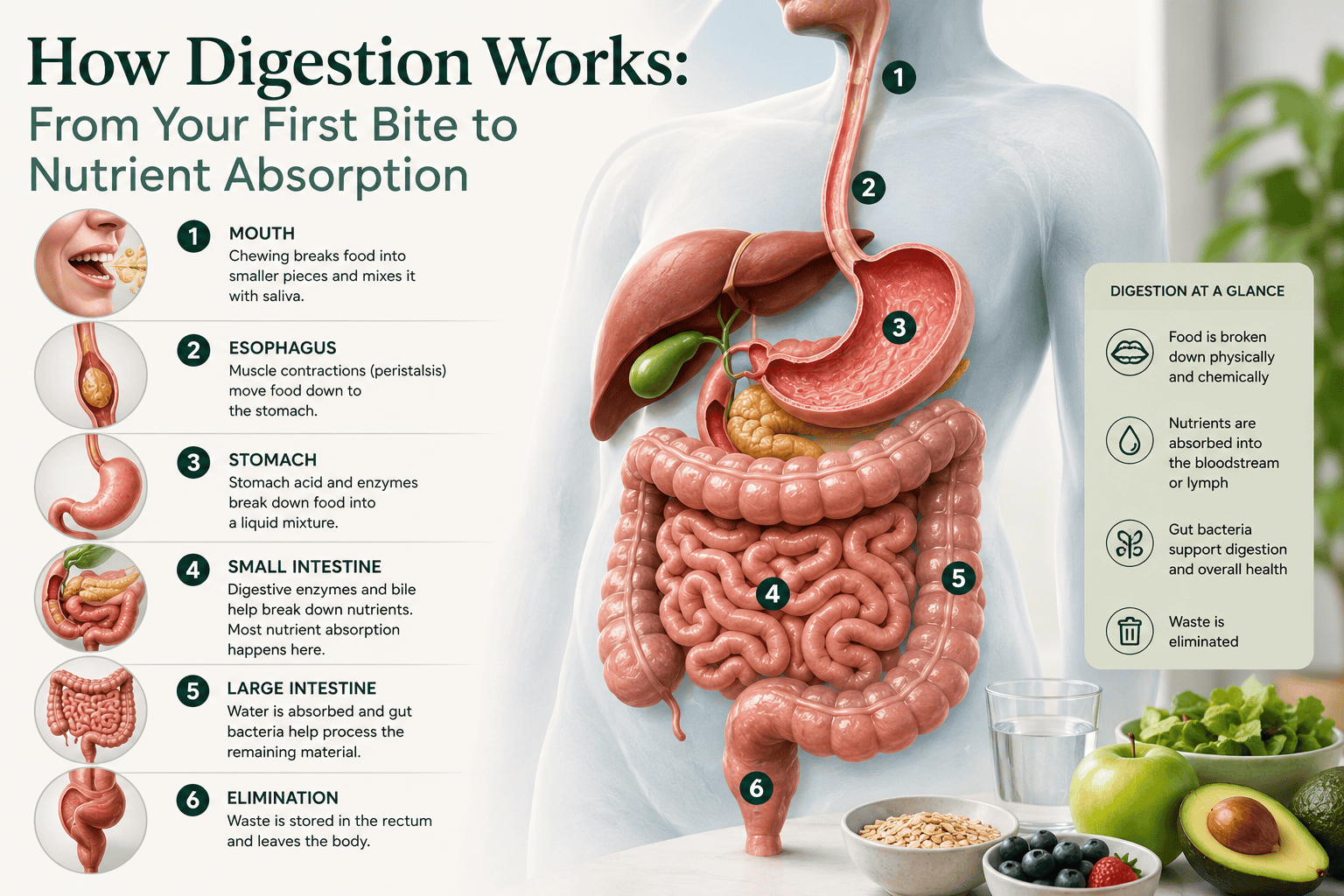
Step 1: Digestion Begins in Your Mouth
Digestion starts before food ever reaches your stomach.
When you chew, your teeth physically break food into smaller pieces. This increases the surface area available for digestive enzymes to work on.
Your salivary glands also release saliva, which moistens the food and makes it easier to swallow. Saliva contains enzymes that begin breaking down starches, which are a type of carbohydrate.
Once you’ve chewed and swallowed, your tongue helps move the food toward your throat and into the esophagus.
The digestive process has officially begun.
Step 2: Your Esophagus Moves Food to Your Stomach
After you swallow, you don’t have to consciously push the food all the way to your stomach.
Instead, your esophagus uses rhythmic muscular contractions called peristalsis.
These contractions push food downward through the esophagus and toward the stomach.
According to NIDDK’s explanation of the digestive system, peristalsis continues throughout much of the digestive tract, helping move and mix food as digestion progresses.
At the bottom of the esophagus is a ring of muscle called the lower esophageal sphincter. It normally relaxes to allow food into the stomach and then closes to help prevent stomach contents from flowing back upward.
Step 3: Your Stomach Mixes Food With Digestive Juices
Once food reaches your stomach, the stomach muscles begin mixing it with digestive juices.
Your stomach lining produces acid and digestive enzymes. The acidic environment helps with digestion, particularly the breakdown of proteins.
The stomach doesn’t simply store food. It acts more like a mixing chamber, gradually turning the meal into a partially digested mixture.
The stomach then slowly releases this mixture into the small intestine.
This controlled release is important because much of the actual nutrient digestion and absorption takes place farther along the digestive tract.
Step 4: The Small Intestine Does the Heavy Lifting
The small intestine is where a tremendous amount of digestion and nutrient absorption takes place.
As partially digested food enters the small intestine, it mixes with digestive substances produced by the pancreas and liver.
The pancreas produces digestive enzymes that help break down carbohydrates, proteins, and fats.
The liver produces bile, which helps the body digest fats. Bile is stored in the gallbladder between meals and released into the small intestine when needed.
You can read more about the roles of these organs in NIDDK’s overview of how the digestive system works.
The small intestine also produces digestive juices of its own, helping complete the breakdown of food.
By this stage, carbohydrates, proteins, and fats have been broken down into much smaller components that can be absorbed.
Step 5: Nutrients Are Absorbed
This is one of the most important parts of digestion.
Breaking food down isn’t enough. Your body also has to get those useful nutrients out of the digestive tract and into circulation.
Most nutrient absorption occurs in the small intestine.
Specialized cells lining the small intestine allow digested nutrients to cross into the body’s circulation.
According to NIDDK, absorbed nutrients such as simple sugars and amino acids enter the bloodstream and are transported to other parts of the body. Fatty acids and some vitamins are absorbed through the lymphatic system.
Once absorbed, nutrients can be used for energy, stored for later, or incorporated into the structures and processes your body needs for everyday function.
This is why digestion and nutrition are so closely connected.
The foods you eat provide the raw materials — but your digestive system has to make those materials available for your body to use.
Step 6: What Happens in the Large Intestine?
After most of the useful nutrients have been absorbed, the remaining material moves into the large intestine.
The large intestine has several important jobs.
One is absorbing water.
The large intestine also contains a large population of microorganisms that interact with the material passing through the digestive tract. These microorganisms can help break down certain components that weren’t fully digested earlier.
The National Center for Biotechnology Information (NCBI) describes the digestive tract as a system responsible not only for digestion but also for moving waste through the body.
Eventually, the remaining material becomes stool and is stored in the rectum until it leaves the body.
Where Does the Gut Microbiome Fit In?
This is where our previous article about the gut microbiome connects directly to digestion.
Your digestive system doesn’t work entirely on its own.
Microorganisms living throughout the gastrointestinal tract interact with the food and other material passing through it. NIDDK notes that bacteria in the GI tract can help with digestion, while research continues to uncover the many ways the microbiome interacts with human health.
In particular, microorganisms in the large intestine can help break down certain components of food that escape digestion earlier in the process.
This is one reason dietary fiber is so interesting.
Humans cannot fully digest many types of dietary fiber themselves. Some fibers reach the large intestine, where gut microorganisms can ferment them and produce compounds called short-chain fatty acids.
This connection between food, digestion, the microbiome, and the compounds produced by gut bacteria will become increasingly important as we continue building our Gut Health topic cluster.
Digestion Isn’t Just About the Digestive Organs
There’s another fascinating part of digestion that is easy to overlook: your nervous system and hormones help coordinate the entire process.
Your digestive tract contains its own extensive network of nerves, known as the enteric nervous system.
Hormones and nerve signals help regulate digestive juices, movement through the GI tract, appetite, and other digestive functions.
NIDDK explains that signals travel both within the gastrointestinal tract and between the digestive system and the brain.
So when we talk about “gut health,” we’re talking about a system that is connected to much more than simply the organs that digest food.
How Long Does Digestion Take?
There isn’t one exact amount of time that applies to everyone.
Food moves through the digestive tract at different rates depending on the individual, the meal, and other physiological factors.
The digestive tract is designed to move its contents gradually. This gives the body time to mechanically and chemically break food down and absorb nutrients.
Rather than thinking of digestion as a single event, it’s more accurate to think of it as a series of coordinated stages.
Eat → digest → absorb → use → eliminate.
Each stage depends on the ones before it.
What Can Support Healthy Digestion?
It’s important to distinguish between supporting normal digestive function and treating a digestive disease.
For generally healthy people, some of the basic principles that support overall digestive health include:
- Eating a varied diet
- Getting adequate dietary fiber
- Drinking enough fluids
- Eating a variety of plant foods
- Being physically active
- Paying attention to foods that consistently cause digestive discomfort
- Getting adequate sleep
- Managing stress as part of an overall healthy lifestyle
These aren’t magic solutions, and they aren’t substitutes for medical care when something is wrong.
Persistent abdominal pain, unexplained weight loss, blood in the stool, ongoing diarrhea or constipation, difficulty swallowing, or other concerning symptoms deserve evaluation by a qualified healthcare professional.
The Bottom Line of How Digestion Works
Digestion is a carefully coordinated process that begins in your mouth and continues through the entire gastrointestinal tract.
Your teeth and saliva begin breaking food down. Your esophagus moves it toward the stomach. The stomach mixes food with acid and enzymes. The pancreas, liver, and gallbladder contribute important digestive substances. The small intestine completes much of the digestion and absorbs most nutrients. Finally, the large intestine absorbs water and helps prepare the remaining material for elimination.
And underneath all of this is a living ecosystem of microorganisms that interacts with what you eat and with the environment inside your digestive tract.
Understanding this basic process gives us a foundation for understanding the next major piece of the puzzle: fiber and its relationship with digestion and the gut microbiome.
Sources & Further Reading
- National Institute of Diabetes and Digestive and Kidney Diseases (NIDDK). Your Digestive System & How It Works
- National Center for Biotechnology Information (NCBI Bookshelf). The Digestive System
- National Library of Medicine / PubMed. Physiology, Digestion
- National Institute of Diabetes and Digestive and Kidney Diseases (NIDDK). Nutrient Metabolism, Status, & Assessment
- National Institute of Diabetes and Digestive and Kidney Diseases (NIDDK). How a Gut “Feeling” Helps Digestion