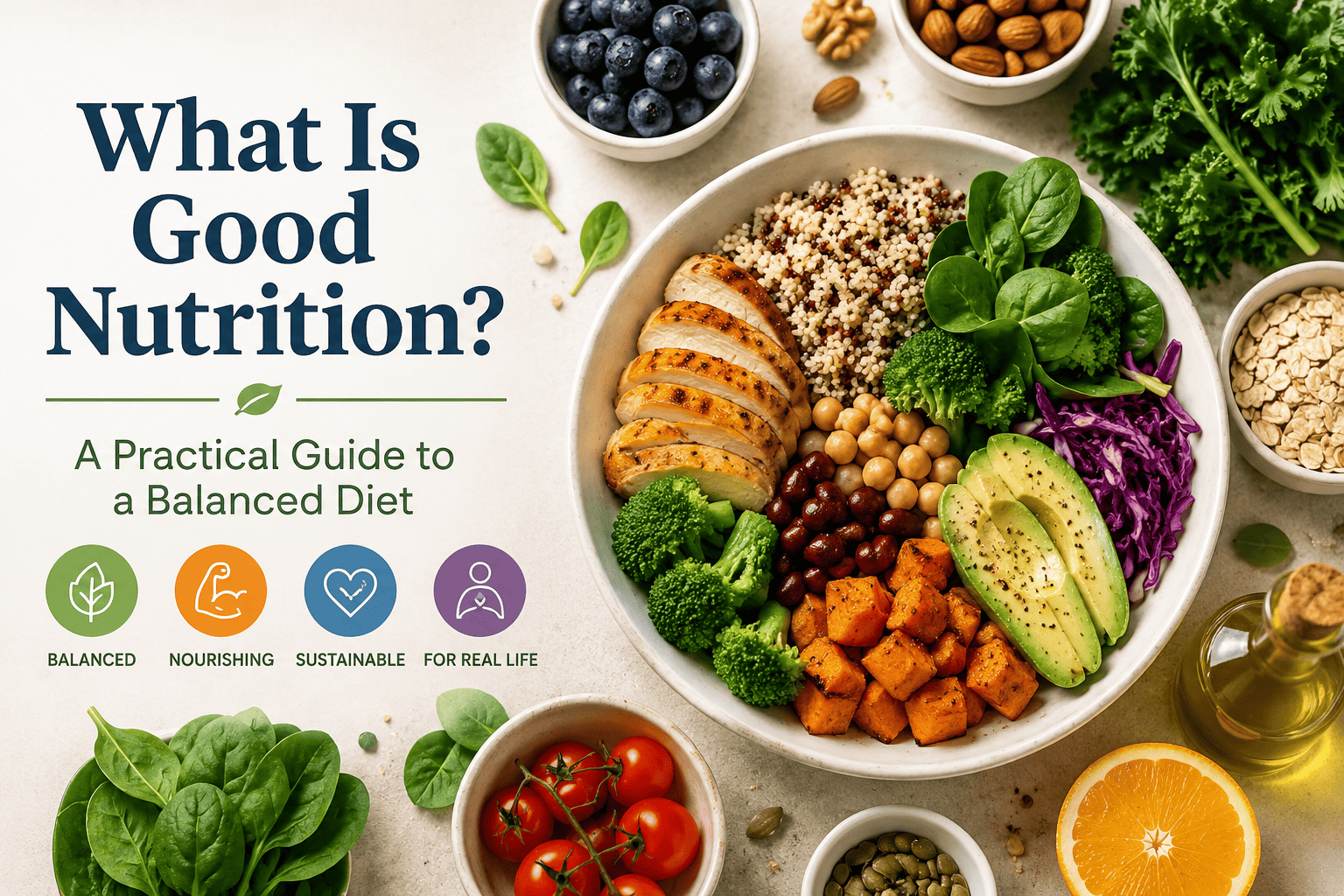
What Is Good Nutrition? A Practical Guide to a Balanced Diet
Category: Nutrition
Nutrition advice can seem confusing.
One person says you need more protein. Another says carbohydrates are the problem. Someone else recommends cutting out entire food groups, taking a long list of supplements, or following the latest popular diet.
But good nutrition doesn’t have to be complicated.
At its foundation, good nutrition is about providing your body with the energy and nutrients it needs while building an eating pattern that is varied, balanced, and sustainable.
There isn’t one perfect diet that works for everyone. Your nutritional needs can vary depending on factors such as age, activity level, health status, culture, food availability, and personal preferences.
The World Health Organization (WHO) describes a healthy diet around four broad principles: adequacy, balance, moderation, and diversity.
Those principles provide a useful starting point for understanding what good nutrition actually looks like.
What Is Nutrition?
Nutrition is the process through which your body obtains and uses the nutrients and energy it needs to function.
Food provides more than calories. It supplies proteins, carbohydrates, fats, vitamins, minerals, water, and other compounds that the body uses for energy, growth, repair, regulation, and normal physiological processes.
Some nutrients are needed in relatively large amounts and are called macronutrients:
- Carbohydrates
- Protein
- Fat
Other nutrients are needed in much smaller amounts and are called micronutrients:
- Vitamins
- Minerals
Water is also essential for life and plays numerous roles throughout the body.
A healthy eating pattern needs to provide enough of these essential nutrients without consistently providing excessive amounts of energy or nutrients that may be harmful when consumed in excess.
This is one reason nutrition is about more than simply counting calories.
What Does a Balanced Diet Mean?
A balanced diet isn’t a specific menu or a rigid set of foods.
Instead, balance means getting an appropriate combination of nutrients and energy from a variety of foods.
The WHO and Food and Agriculture Organization’s 2024 joint statement on healthy diets explains that healthy diets can look different depending on individual circumstances, culture, food availability, and preferences while still sharing fundamental principles.
A balanced eating pattern generally includes a variety of:
- Vegetables
- Fruits
- Whole grains and other minimally processed grains
- Beans, peas, and lentils
- Nuts and seeds
- Protein-rich foods
- Dairy or suitable alternatives
- Healthy sources of dietary fat
It also generally limits excessive amounts of foods and beverages high in added or free sugars, sodium, saturated fat, and industrially produced trans fat.
The goal isn’t perfection.
It’s the overall pattern of your diet that matters.
The Three Macronutrients
Macronutrients provide energy and perform important structural and regulatory functions in the body.
Carbohydrates
Carbohydrates are one of the body’s primary sources of energy.
They are found in foods such as fruits, vegetables, grains, beans, lentils, and many dairy products.
Carbohydrates can take different forms. Some are rapidly digested, while others are digested more slowly. Dietary fiber is also a type of carbohydrate that plays important roles in digestive health and other aspects of nutrition.
The WHO recommends that carbohydrates come primarily from foods such as whole grains, vegetables, fruits, and pulses rather than relying heavily on refined carbohydrate sources and foods high in free sugars. (WHO)
This doesn’t mean carbohydrates are inherently “good” or “bad.”
The food providing the carbohydrate matters.
An apple, a bowl of oatmeal, and a sugar-sweetened beverage all contain carbohydrates, but they provide very different combinations of fiber, vitamins, minerals, and other nutrients.
We’ll explore carbohydrates in much greater detail in a future Calm Health Lab article.
Protein
Protein provides amino acids that the body uses to build and maintain tissues and to produce many functional molecules.
Protein is found in foods such as:
- Fish
- Poultry
- Eggs
- Dairy products
- Beans
- Lentils
- Soy foods
- Nuts
- Seeds
Protein needs vary between individuals.
Factors such as age, body size, pregnancy, health status, and physical activity can affect nutritional needs.
Rather than assuming that everyone needs a high-protein diet, it’s more useful to consider whether your overall eating pattern provides adequate protein from a variety of foods.
We’ll take a much closer look at protein—including protein quality, food sources, and individual needs—in a future article in this Nutrition cluster.
Dietary Fat
Dietary fat is an essential nutrient.
Your body needs fat for functions including cell structure, energy storage, absorption of certain vitamins, and production of important molecules.
But different types of dietary fat have different effects on health.
Unsaturated fats, found in foods such as nuts, seeds, fish, avocados, and many plant oils, are generally preferred over saturated fats and industrially produced trans fats.
The WHO recommends replacing saturated and trans fats with unsaturated fats where possible. (WHO)
This is another area where simple labels such as “fat is bad” don’t tell the whole story.
The type and source of fat matter.
We’ll explore the different types of dietary fat in a dedicated article later in this Nutrition series.
Vitamins and Minerals: The Micronutrients
Vitamins and minerals are required in much smaller amounts than carbohydrates, protein, and fat, but that doesn’t make them unimportant.
They participate in hundreds of biological processes.
For example:
- Iron is important for oxygen transport.
- Calcium contributes to bones and teeth and is involved in muscle and nerve function.
- Vitamin C is involved in collagen formation and supports normal immune function.
- Folate is important for DNA synthesis and cell division.
- Vitamin D helps regulate calcium metabolism and contributes to bone health.
The body needs different amounts of different micronutrients, and both deficiencies and excessive intake of certain nutrients can cause problems.
The NIH Office of Dietary Supplements provides detailed information about recommended nutrient intakes and the roles of individual vitamins and minerals.
For most people, getting nutrients from a varied diet is an important foundation.
That doesn’t mean supplements are never useful. Certain people may benefit from supplementation because of dietary restrictions, life stage, medical conditions, medications, or documented deficiencies.
But more isn’t automatically better.
We’ll explore vitamins, minerals, and when supplements may be appropriate in a future article.
Why Variety Matters
One of the simplest principles of good nutrition is variety.
Different foods provide different combinations of nutrients and other beneficial compounds.
For example, leafy green vegetables provide nutrients that differ from those found in berries, beans, whole grains, nuts, fish, or dairy foods.
Eating a diverse range of foods makes it easier to obtain a broad spectrum of nutrients.
The WHO identifies diversity as one of the core principles of a healthy diet and recommends eating a variety of foods across and within food groups. (WHO)
This is one reason a diet built around a wide range of minimally processed and nutrient-dense foods can be more useful than focusing intensely on a single “superfood.”
No individual food needs to provide everything your body needs.
What Does “Nutrient-Dense” Mean?
You will often hear the term nutrient-dense in nutrition discussions.
A nutrient-dense food provides a relatively high amount of beneficial nutrients compared with its calorie content.
Examples can include:
- Vegetables
- Fruits
- Beans and lentils
- Whole grains
- Nuts and seeds
- Fish
- Eggs
- Yogurt
- Other nutrient-rich foods
Nutrient density doesn’t mean a food has to be low in calories.
For example, nuts are relatively calorie-dense because they contain substantial amounts of fat, but they also provide protein, fiber, vitamins, minerals, and other compounds.
Thinking about nutrient density can therefore be more useful than simply labeling foods as “low calorie” or “high calorie.”
Whole Foods vs. Processed Foods
“Processed” is another word that can cause confusion.
Almost all food we eat is processed in some way.
Cooking, freezing, drying, grinding, fermenting, and pasteurizing are all forms of food processing.
The more useful distinction is often between foods that have undergone relatively little processing and highly processed foods that may contain substantial amounts of added sugars, sodium, unhealthy fats, or other ingredients.
The WHO notes that minimally processed and unprocessed foods—including fruits, vegetables, whole grains, pulses, nuts, and seeds—can form the foundation of a healthy diet, while foods high in unhealthy fats, free sugars, and sodium should generally be limited. (WHO)
That doesn’t mean every packaged food is unhealthy.
Frozen vegetables, canned beans, plain yogurt, canned fish, and whole-grain bread can all be practical and nutritious choices.
Convenience and nutrition aren’t mutually exclusive.
What About Sugar?
Sugar is not simply a matter of “good” versus “bad.”
Some foods naturally contain sugars along with other nutrients. Whole fruit, for example, contains naturally occurring sugars as well as fiber, vitamins, minerals, and other compounds.
Free sugars are a different category.
The WHO defines free sugars as sugars added to foods and beverages, as well as sugars naturally present in honey, syrups, fruit juices, and fruit juice concentrates.
The WHO recommends limiting free sugars to less than 10% of total daily energy intake, with a further reduction to 5% or less potentially providing additional health benefits. (WHO)
This doesn’t mean you need to eliminate every sweet food from your diet.
It means that foods and drinks high in free sugars are best treated as a limited part of an overall eating pattern.
What About Salt and Sodium?
Sodium is an essential mineral, but consuming too much sodium can contribute to elevated blood pressure in many people.
Much of the sodium in modern diets can come from processed and packaged foods rather than simply from the salt shaker.
The WHO recommends that adults consume less than 2,000 mg of sodium per day, equivalent to less than 5 grams of salt. Individual needs can vary, and people with certain medical conditions may receive different recommendations from their healthcare providers. (WHO)
Reading nutrition labels and choosing lower-sodium versions of frequently eaten foods can be practical ways to reduce intake when needed.
How Much Should You Eat?
There isn’t one calorie target or portion size that is appropriate for everyone.
Energy requirements vary based on factors including:
- Age
- Sex
- Body size
- Physical activity
- Growth
- Pregnancy and breastfeeding
- Other individual circumstances
Your body also regulates energy intake and expenditure through complex biological systems.
This is why a nutrition plan that works well for one person may not be appropriate for another.
Rather than focusing exclusively on a single calorie number, it can be helpful to consider the overall quality and balance of your eating pattern.
For people with specific health or nutrition goals, a registered dietitian or other qualified healthcare professional can help determine appropriate individualized recommendations.
Does Eating Healthy Mean Giving Up Your Favorite Foods?
No.
A healthy eating pattern doesn’t have to be perfect.
Enjoying a dessert, eating at a restaurant, having a favorite snack, or celebrating with a special meal doesn’t automatically make your overall diet unhealthy.
The bigger question is what your usual pattern looks like.
If most of your diet is built around a variety of nutritious foods, there is generally room for foods that are chosen primarily for enjoyment.
This is one reason sustainable nutrition tends to work better than extremely restrictive approaches for many people.
A diet that is theoretically “perfect” but impossible to maintain isn’t particularly useful.
How Gut Health Fits Into Good Nutrition
Nutrition and gut health are closely connected.
The foods you eat provide nutrients to your body, but some components of food also interact with the microorganisms living in your digestive tract.
Dietary fiber is a particularly important example.
Certain types of fiber can be fermented by gut microorganisms, producing compounds such as short-chain fatty acids.
That’s one reason a diet rich in a variety of plant foods can be relevant to both nutrition and digestive health.
If you’d like to learn more, see our What Is Gut Health? guide and our articles on the gut microbiome and dietary fiber and gut health.
As we continue building the Nutrition section, we’ll explore the relationship between specific nutrients and gut health in greater detail.
What About Supplements?
Supplements can be useful in certain circumstances, but they shouldn’t automatically be considered a replacement for a nutritious diet.
Some people may need supplements because of a diagnosed deficiency, increased nutritional requirements, dietary restrictions, pregnancy, certain medical conditions, or other circumstances.
But taking a supplement simply because a nutrient is important doesn’t necessarily mean you’ll benefit from taking extra amounts.
The NIH Office of Dietary Supplements provides evidence-based information about vitamins, minerals, and other dietary supplements, including their potential benefits, safety considerations, and recommended intake levels.
A useful principle is:
Start with food when possible, and use supplements thoughtfully when there is a good reason for them.
If you’re considering a supplement to treat or prevent a specific health condition, it’s worth discussing that decision with a qualified healthcare professional.
What Does a Healthy Eating Pattern Actually Look Like?
There isn’t one perfect menu.
But a practical healthy eating pattern can include a wide variety of foods such as:
Vegetables and fruits
Aim for variety in color, type, and preparation.
Fresh, frozen, and canned options can all contribute to a healthy diet, particularly when canned products don’t contain excessive added sodium or sugar.
Whole grains and other high-fiber carbohydrates
Examples include:
- Oats
- Brown rice
- Whole-grain bread
- Barley
- Quinoa
- Beans
- Lentils
Protein-rich foods
These can include:
- Fish
- Poultry
- Eggs
- Beans
- Lentils
- Soy foods
- Nuts
- Seeds
- Dairy products
Healthy sources of fat
Examples include:
- Olive and other unsaturated plant oils
- Nuts
- Seeds
- Avocados
- Fatty fish
Foods to limit
Depending on your individual circumstances, it can be useful to limit foods and beverages that are consistently high in:
- Free sugars
- Sodium
- Saturated fat
- Industrially produced trans fat
The WHO’s current healthy-diet guidance emphasizes that the foundation should be a diverse range of nutritious foods while limiting these components. (WHO)
Simple Ways to Improve Your Nutrition
You don’t have to completely change your diet overnight.
Small, sustainable changes can be a practical way to improve an eating pattern.
Consider:
1. Add more variety
Try adding a fruit or vegetable that you don’t normally eat.
2. Include more fiber-rich foods
Gradually increase foods such as beans, lentils, vegetables, fruits, whole grains, nuts, and seeds.
3. Choose minimally processed foods more often
This doesn’t mean eliminating packaged foods. It means making nutritious foods the foundation of your usual diet.
4. Pay attention to protein
Include a protein-rich food with meals when appropriate for your nutritional needs.
5. Choose unsaturated fats more often
Foods such as nuts, seeds, fish, avocados, and many plant oils can provide beneficial unsaturated fats.
6. Watch added or free sugars
Pay particular attention to sugar-sweetened beverages and foods that provide large amounts of added sugar without many other nutrients.
7. Don’t aim for perfection
A sustainable eating pattern should fit your life.
Nutrition is not a test you either pass or fail.
The Bottom Line
Good nutrition isn’t about finding one perfect food, one perfect diet, or one perfect set of rules.
It’s about building an overall eating pattern that provides the nutrients and energy your body needs while emphasizing variety, balance, moderation, and nutrient-rich foods.
A strong nutritional foundation generally includes a diverse selection of vegetables, fruits, whole grains, legumes, nuts, seeds, protein-rich foods, and healthy sources of fat while limiting excessive amounts of free sugars, sodium, saturated fat, and industrially produced trans fat.
Your individual nutritional needs may be different from someone else’s, and that’s okay.
The goal isn’t perfection.
The goal is a healthy eating pattern you can understand, enjoy, and maintain.
As we continue building the Calm Health Lab Nutrition section, we’ll take a closer look at the individual pieces of that picture—starting with protein, dietary fiber, carbohydrates, dietary fats, and vitamins and minerals.
Sources and Further Reading
- World Health Organization (WHO) — Healthy Diet
- World Health Organization & Food and Agriculture Organization (FAO) — What Are Healthy Diets? Joint Statement
- NIH Office of Dietary Supplements — Dietary Supplement Fact Sheets
- NIH Office of Dietary Supplements — Nutrient Recommendations and Dietary Reference Intakes
- National Institute of Environmental Health Sciences (NIH) — Nutrition
- U.S. Department of Agriculture — MyPlate
Medical Disclaimer
This article is provided for educational and informational purposes only. It is not intended to replace professional medical advice, diagnosis, or treatment. Individual nutritional needs vary, and people with medical conditions, specific dietary requirements, or concerns about their nutrition should consult a qualified healthcare professional.